Custom Search
Showing posts with label Lam Dong. Show all posts

Tuesday, May 10, 2016

Prosopocoilus astacoides karubei Nagai, 2000

Prosopocoilus astacoides karubei Nagai,2000 was described based on materials that collected from Lam Dong Province, South Center of Vietnam. It is the second subspecies of the species found in Vietnam, other wide distribute subspecies is Prosopocoilus astacoides castaneus (Hope & Westwood, 1845), found in North of Vietnam and very common in Ha Giang Province. Not same to the subspecies Prosopocoilus astacoides karubei only found from type locationProsopocoilus astacoides castaneus found also in Thailand, Myanmar, India and Laos, maybe also in South China.
The subspecies Prosopocoilus astacoides karubei Nagai,2000 named after Mr. Haruki Karube, Kanagawa Museum of Nature History, who is well known with his publication on dragonfly of South East Asia.


 Small male of Prosopocoilus astacoides karubei Nagai,2000 - photographed by Nguyen Ba Quang


Large male of Prosopocoilus astacoides karubei Nagai,2000 - Photographed by Nguyen Quang Thai


Trachyzulpha frushtorferi varia Gorochov, 2014

Trachyzulpha frushtorferia varia Gorochov, 2014 was original described based on materials that collected from Kon Tum Province, South Center of Vietnam. The holotype of the subspecies was collected from Kon Plong, Mang Canh with elevation about 1200m. It is the first time this subspecies was recorded from Bidoup, Lam Dong Province, South Center of Vietnam. It was attracted by light trap in the locality with elevation about 1650m. It is easy to understand about the distribution because of connection of two forest mountain areas in South Center of Vietnam.
Species of Trachyzulpha found in tropical forests in Indo-Malay area, the genus was described based on the species T. frushtorferia from Java, Indonesia. The latter second species was found from Tonkin, North Vietnam: T. annulifera. Today, Trachyzulpha frushtorferia was found from South China and South East Asia. In Vietnam, there only 2 species of the genus were recorded: T. frushtorferia and T. annulifera.
They are really beautiful and strange species of Grasshopper with the lichen mimic form, they fround in pristine tropical forest.


Trachyzulpha frushtorferia varia Gorochov, 2014 - photographed by Cuong Do, 2016 in Bidoup National Park, Lam Dong Province


Thursday, April 28, 2016

Taeniodera cupreicollis (Bourgoin, 1924)

Taeniodera cupreicollis (Bourgoin, 1924) has been found only South Vietnam since it was described by Bourgoin in 1924 of the genus Macrontona. The type locality is Di Linh, Lam Dong Province. The species belong to T. egregia group. In Vietnam, there are 7 species of Taeniodera were recorded, and 4 of them are considered be endemic to the fauna of the country.


Taeniodera cupreicollis (Bourgoin, 1924) Photos taken by Do Thanh Cong


Monday, April 25, 2016

Poecilocoris latus Dallas, 1848

Poecilocoris latus Dallas, 1848, a beautiful bug and known as a pet of tea plantation. It is a member of Scutelluridae family, Hemiptera/Heteroptera order. Members of the family characteristic with well developed of scutellum and covered the rest part of the body make them be similar to a beetle. They usually very colorful with brighten sport and shining metallic color body. They are true bugs so they life cycle without pupa phrase (incomplete metabolism).


Immature form of Poecilocoris latus Dallas, 1848 - photos taken by Do Thanh Cong


Friday, March 25, 2016

Megaloxantha bicolor porphyreus Hou & Wu, 1996

The species Megaloxantha bicolor is found from India to South East Asia and Australia. They are large size buprestid beetle. There are 13 subspecies of the species have been recorded. In Vietnam the subspecies Megaloxantha bicolor porphyreus Hou & Wu, 1996 was found from Bao Lam, Bao Loc, Lam Dong Province.


Megaloxantha bicolor porphyreus Hou & Wu, 1996

Monday, March 21, 2016

Samia vuvanlieni Naumann, Peigler & Läffle, 2014

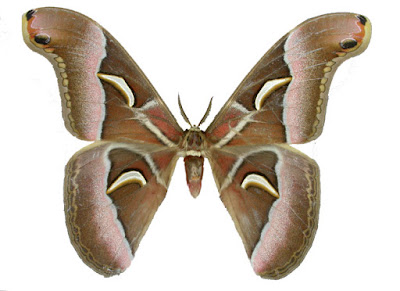
A new described species of Saturniidae in 2014, the species is large size moth that found from Bidoup National Park, Lam Dong Province, they also were recorded in Kon Tum and Da Nang Province. The species is largest moth of the genus, two smaller related species are S. watsoni and S. formosana. Mature form found in high elevation habitat, about more than 1500m.


Samia vuvanlieni Naumann, Peigler & Läffle, 2014 - dorsal view of male


Wednesday, June 17, 2015

Aegosoma george Do, 2015 new species of Prioninae from South Vietnam


As reviewing the genus Aegosoma, the author found a new species of the genus from South Vietnam, and it was named after an cartoon character, George Pig, Aegosoma george.

Male and female of Aegosoma george

Male of holotype of Aegosoma george

George is a character in the children's cartoon video series 'Peppa Pig', which is produced by the English television entertainment company Astley Baker Davies Ltd. George is Peppa's little brother and the youngest member in the family. The author's five-year old son suggested George as the species epithet for this new Aegosoma, because A. george is the latest discovery in the genus.

George Pig in blue, he love playing with dinosaur toy and he is youngest member in Peppa Pig family


George Pig and Peppa Pig


Wednesday, June 18, 2014

Teinopalpus aureus from Vietnam

Teinopalpus aureus is a rare buttefly that found from high elevation forests. In Vietnam, there has been two subspecies of T. aureus, Teinopalpus aureus shinkaii and Teinopalpus aureus eminens. They are Papilionidae butterflies that listed as protected species.

The subspecies Teinopalpus aureus eminens was described by Turlin in 1991, the male holotype was collected from Dong Nai, South Vietnam (elevation is 1500m) and deposited in Nature History Museum, London, England. The subspecies later be found many high land area in South Vietnam: Di Linh and Bidoup National Park, Lam Dong Province, Dak Nong Province, Hon Ba Nature Reserve, Khanh Hoa Provicne. Recently the subspecies also was found in center of Vietnam (Vu Quang National Park, Ha Tinh Province).


Dorsal view of male of Teinopalpus aureus eminens, Dak Nong Province.

Mr. Shinkai collected materials of Teinopalpus aureus from Pia Oac Mountain, Cao Bang Province in 1995 and Tam Dao National Park, Vinh Phuc Province from 1990 - 1998. Based on the materials, Morita described the new species and named after Mr. Shinkai, the paper was published in 1998 with the hotoype is male specimen from Pia Oac, Cao Bang, this holotype is deposited in Morita's collection. Recent year, the subspecies also was recorded from Pu Mat, Nghe An Province, North Center of Vietnam.


A male of Teinopalpus aureus shinkaii Morita, 1998, dorsal view (Tam Dao National Park, Vinh Phuc Province)

Teinopalpus aureus shinkaii and Teinopalpus aureus eminens males can be separated by the shape of yellow triangle cell of the hind wings. The triangle cell of shinkaii is much more larger than it of eminens.

 
Triangle cells of hind wings of T. aureus shinkaii (left) and T. aureus eminens (right).

Wednesday, June 4, 2014

Weinreichius perroti Laxcroix, 1978

The genus Weinreichius consist of a single species Weinreichius perroti and this species has known as an endemic taxon from South of Vietnam, near Da Lat area. The distribution of the species has been recorded in high land area of Lam Dong Province, South Vietnam.

In general, this species quite similar to another Vietnamese endemic species, Yumikoi makii that only found from South Center of Vietnam. Mature forms of Weinreichius perroti mainly found from April to September during the year. Their habitat is mountain forests with elevation over 1000m.

Male of W. perroti in nature, Bidoup Nui Ba National Park, Lam Dong Province

Female of W. perroti in nature, Bidoup Nui Ba National Park, Lam Dong Province

Dorsal view of a male specimen


Tuesday, May 20, 2014

Aegosoma xentoc Do & Drumont, 2014

In the entomological survey to South Vietnam, we found a new species of Aegosoma (Prioninae, Cerambycidae) from Lam Dong Province. The species was found in pristine forests with elevation about more than 1200m. Specimens were collected in 2013 and the description was published in 2014 based on both males and females.

The species is typical with long antenna and red brown in color, costae of elytra are visible clearly. It is medium large prionid beetle and difference from any known Aegosoma, it also not belong to any known group of the genus. Name of the species means "long horn beetle"  in Vietnamese.


Male of Aegosoma xentoc, figure made by Cuong Do from holotype

Tuesday, April 22, 2014

Actias chapae bezverkhovi Sochivko & Ivshin, 2008

This species is one of the most beautiful moth of Saturniidae family that found from Vietnam with very long tails of the hind wings.  The species was described based on material that collected from Sa Pa (as its name, Chapa), Lao Cai Province.

Since 2008, two subspecies of Actias chapae have been found: A. chapae chapae and A. chapae bezverkhovi. The previous subspecies distributed in North Vietnam and South of China and the later is only found from South Vietnam. They are high elevation moths and live in pristine forests with high level of humidity. A. chapae bezverkhovi be in mature form in April to October duration of the year. The subspecies was record in 2 provinces, Lam Dong and Dak Lak.


Male, photographed by Cuong Do, Chu Yang Sin National Park, Dak Lak

Wednesday, April 16, 2014

Rhinocypha seducta Hamalainen & Karube, 2001

Base on specimens that were collected from Bao Loc, Lam Dong Province, in 2001, Hamalainen and Karube described this species as a new for science. Now, their distribution was reported in many localities of high land in south of the country.

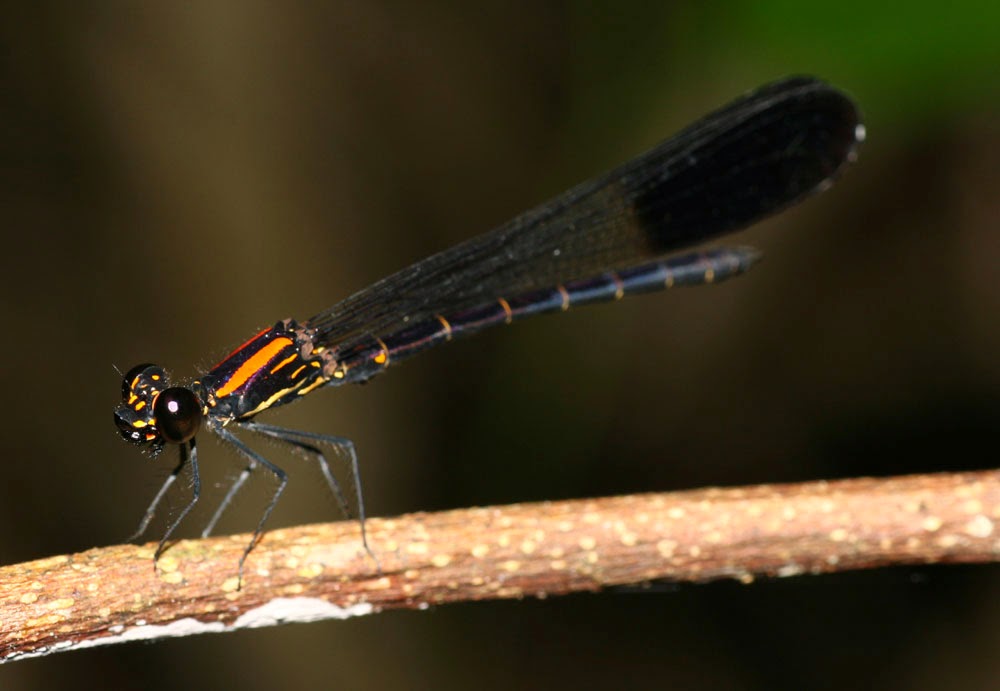
It is colorful and enigmatic species, a rare species but quite common locally. Males and females are similar but females are lightly duller. In males, the head is deep black with orange-red spots marking, the thorax dull black with dark orange-red strips on thorax on both dorsal and lateral sides. The fore wings are hyaline; each hind wing is hyaline with an apical iridescent spot. The abdomen is somehow elongate, dull black and unicolour.


The species lives in pristine or lightly disturbed forests on high lands of Southern Vietnam, where the temperature is not too high and they are very humid forests. The mature forms do not fly very far from their breeding sites, so they are not so active insects. Males of this species usually perch up above the water which is muddy streams. They fly up and down and spend most of the time for perching on leafs or branches of trees above the stream. They are very sensitive to temperature and humidity of environment. They usually perched very high up to the canopy, and they got down gradually as sunlight went directly to the surface of the forest. Hiding in deep shade of the forest, they got down and perched near the stream where the humidity high enough. But immediately, after the sun was covered by clouds, they flew up to the higher positions. Their territory is very narrow area but they some time have vivid courtship daces, the male try to protect his own territory by showing to his neighbour the golden flash spots of his hind wings and the action just little above the water surface.

Male, photographed by Cuong Do, Da Lat, Lam Dong

Face and thorax of male, photographed by Cuong Do, Da Lat, Lam Dong

Aristocypha fenestrella (Rambur, 1842)

Aristocypha fenestrella is one of the odonate species with wide range of altitudinal distribution (0-1700 m). It is one of several common mountain stream damselflies and widespread species.

They are small glittered damselfly with broad violet wings. The body of male is deep black basically with some yellow stripes on thorax and a particular triangular purple marking on dorsal of synthorax. Head is uncoloured black in both male and female with the swollen clypeus as characteristic of the family. Fore wings are narrow, hyaline and some how brownish and hind wings are much broader, with shining violet cell areas insert into dark background. Wings of female just are hyaline or hyaline-brownish. Legs of mature male are very typical with tibia developed to be broader and white coloured. The colours of teneral males usually are fader than it of mature forms.

Those damselflies usually are found in the primary forests, the mature forms fly around their breeding sites which are clear, swift streams. Although they are forest species, this species is quite common, they are widespread species and could be found in whole of the country.

It is one of the most active species of the family with and males are strict territorial individuals. Each male usually appropriates a micro-habitat (a rock, floating timber or a branch of tree..) near the water surface. And when another male enters his territory, rival flying dance will be observed. In courtship flying dance of male and female, or rival flying dance of males, the male usually stay-flies in the air and shows his flash violet hind wing and white tibia of his legs to the partner. A territorial flying between two males take place from some second to many minutes.

Larvae of the species live in sand, gravel swift streams; they are very typical with two long filament gills at the end of abdomen.

Young male, photographed by Cuong Do, Ba Vi National Park

Mature male in full color, photographed by Cuong Do, Hon Ba, Khanh Hoa

Mature male in full color, photographed by Dang Ngoc Tu, Tu Son, Hoa Binh

Female, photographed by Cuong Do, Hon Ba, Khanh Hoa


Devadatta cyanocephala Hamalainen, Sasamoto & Karube, 2006

In 1995, Jan Van Tol reported about three females of this species in his field trip to Bach Ma National Park, and based on the characteristic of wing venation of females he believed that it is unknown species he did not name it as a new species for science cause of lacking male. Latter Haruki Karube, Akihiko Sasamoto and Matti Hamalainen did the description of this species independently base on males and females of the species that collected from the same locality and Bao Loc Province. Finally, three of them cooperated to publish the description of the species in 2006, 10 years later after Jan Van Tol's report. Name of the species specifies its blue face.

They are medium size damselflies head is typical with brighten cream bluefish marking of their face. Body is black brownish in general with cream yellowish marking on thorax and abdomen, legs short and robust. Wings are hyaline with an apical fate dark spot, they usually fold wings at rest, and they rarely open the wings as resting. They were found in clear streams in tropical forest of Limestone Mountains, in Bach Ma - Thua Thien Hue and recently were recorded in Hon Ba - Khanh Hoa and Lam Dong - Bao Loc. Although they are very common at the habitat sites but they have only been known in the centre and south of Vietnam. They are weak flied damselfly, and do not fly too far from the breeding sites, the mature forms usually fly in shade of the forest but occasionally they can be found near waterfalls, in sunshine.


Male of D. cyanocephala, photographed by Cuong Do in Bach Ma, Thua Thien Hue

Female of D. cyanocephala, photographed by Cuong Do, Bach Ma, Thua Thien Hue


Sunday, March 30, 2014

Komiyasoma lei Drumont & Do, 2013

In the field trip last year (2013), we collected some strange specimens that closed to the new described genus Metaegosoma which consisted of two members, M. annamensis and M. pinci.

After examination the series of materials from South Center of Vietnam, we concluded that it is an undescribed genus then erected the genus Komiyasoma that obtained only single species K. lei.
The species is seem to an endemic species and found from highland forests in South Center of Vietnam.
The species was named after Mr. Le Van Huong, director of Bidoup National Park, Lam Dong Province while the name of the genus for honor Mr. Ziro Komiya, a Japanese who contributed many works on taxonomy of Prioninae of the World.

Male paratype of K. lei

Female paratype of K. lei


Tuesday, February 25, 2014

Kibakoganea Nagai, 1984

The genus Kikobaganea was erected by Nagai in 1984 as subgenus of Fruhstoferia, Hirasawa promoted it to genus level in 1992. Their typical characteristic is the inner lobe on basal lateral edge of each pronotum side. There are total 14 known species around South East Asia and South China. And they belong to 3 groups (based on structure of the male genitalia organ):


Group 1 with very short and apex separated parameres:

K. formosana (Kurosawa & Kobayashi, 1975) (Do Collection)

This species is endemic in Taiwan, they are quite smaller than other member of the genus, they are green/yellow with black part marking beetles.


K. sinica Bouchard


K. kraatzi Miyake & Muramoto, 2003

This first known from Vietnam then later found from South China and Hainan, the species had been misidentified with K. sexmaculata in a long time but later be described as a new species.


K. opaca Muramoto, 1993 (Do Collection)

This species found from China and recently be recorded from North Vietnam.


Group 2 with longer and not separated parameres which are asymmetrical:


K. kawaii Muramoto, 2005


K. koyamai (Hirasawa, 1989) (Do Collection)


K. kumei (Hirasawa, 1989) (Do Collection)

Last group, group 3, genitalia with not separated and symmetrical parameres:


K. dohertyi (Ohaus, 1905)


K. fujiokai Miyake & Muramoto, 1992 (Do Collection) - Male

Male of K. fujiokai, photographed by Cuong Do, Lam Dong Province


K. fujiokai Miyake & Muramoto, 1992 Female, laying her egg in breeding box. Specimens collected from Lam Dong Privnce


K. sexmaculata (Kraatz, 1900) (Do Collection)
This species is the most early known species among members of the genus. It was first recorded from North Vietnam then be found wider distribute in the area later. The type locality of the species is same to K. kraatzi

K. tamdaoensis Miyake & Muramoto

K. vernicata (Benderitter)

K. canhcamsung Do, 2013 (male holotype) from Tay Giang, Quang Nam Province

K. yoshitomii Nagai