Custom Search
Showing posts with label Khanh Hoa. Show all posts

Wednesday, June 18, 2014

Teinopalpus aureus from Vietnam

Teinopalpus aureus is a rare buttefly that found from high elevation forests. In Vietnam, there has been two subspecies of T. aureus, Teinopalpus aureus shinkaii and Teinopalpus aureus eminens. They are Papilionidae butterflies that listed as protected species.

The subspecies Teinopalpus aureus eminens was described by Turlin in 1991, the male holotype was collected from Dong Nai, South Vietnam (elevation is 1500m) and deposited in Nature History Museum, London, England. The subspecies later be found many high land area in South Vietnam: Di Linh and Bidoup National Park, Lam Dong Province, Dak Nong Province, Hon Ba Nature Reserve, Khanh Hoa Provicne. Recently the subspecies also was found in center of Vietnam (Vu Quang National Park, Ha Tinh Province).


Dorsal view of male of Teinopalpus aureus eminens, Dak Nong Province.

Mr. Shinkai collected materials of Teinopalpus aureus from Pia Oac Mountain, Cao Bang Province in 1995 and Tam Dao National Park, Vinh Phuc Province from 1990 - 1998. Based on the materials, Morita described the new species and named after Mr. Shinkai, the paper was published in 1998 with the hotoype is male specimen from Pia Oac, Cao Bang, this holotype is deposited in Morita's collection. Recent year, the subspecies also was recorded from Pu Mat, Nghe An Province, North Center of Vietnam.


A male of Teinopalpus aureus shinkaii Morita, 1998, dorsal view (Tam Dao National Park, Vinh Phuc Province)

Teinopalpus aureus shinkaii and Teinopalpus aureus eminens males can be separated by the shape of yellow triangle cell of the hind wings. The triangle cell of shinkaii is much more larger than it of eminens.

 
Triangle cells of hind wings of T. aureus shinkaii (left) and T. aureus eminens (right).

Tuesday, April 22, 2014

Neurobasis chinensis (Linnaeus, 1758)

This is quite common Asian species and is one of the earliest known species of dragonfly. It was named by Linnae based on a picture in book cover of bird. And because in the picture the specimen was drawn with the wings in horizontal position, this species formerly was put in Anisoptera suborder by Linnae. Name of species is specified its locality, from China.

The medium sized damselfly, this species has shining green body and hind-wing is metallic green. The head, thorax and abdomen of the male are metallic green while female has fader green body. The wings of the male distinguish from them of the female. Female’s fore-wing has a white spot at pterosigma position – psedopterostigma, while male’s fore-wings are dust yellowish hyaline and instead of psedopterostigma, there is a white spot at nodus position. The hind-wings of female are shinning colorful, metallic green with an apical black patch on upper side and they are quite dust yellowish hyaline in female.


They are very active damselflies, and live at open swift streams from low to high lands. They never fly far from their breeding habitat; males are strict in territorial defense by showing their flash metallic green hind-wings. Males fly very close to the water surface while females usually perch on vegetations nearby. In courtship flying, males usually keep the hind-wing open in horizontal position to show the flash green upper surface of the wings under sunshine. Sometime males just clap their hind-wings as resting and the action is signal to other males in territorial informing or to coming females for mating. Females insert their eggs into aqua vegetation tissue; in many cases, female sinks in the water during the oviposition while the male around.

Male, photographed by Cuong Do, Ba Vi

Male, photographed by Cuong Do, Pioac Nature Reserve, Cao Bang Province

Male, showing his hind wing in opened position, photographed by Cuong Do, Hon Ba Nature Reserve, Khanh Hoa Province


Friday, April 18, 2014

Euphaea guerini Rambur, 1842

Formerly, together with E. masoni, this species was known as subspecies taxon level but now it is believed to belong into a distinct species. Tol 1995, proposed distributional evident of them in Vietnam and in his papers two species were separated in geography. However two species have been reported at the same stream of a secondary forest in Quang Binh Province so they must be also distinguished in ecology and behaviors.

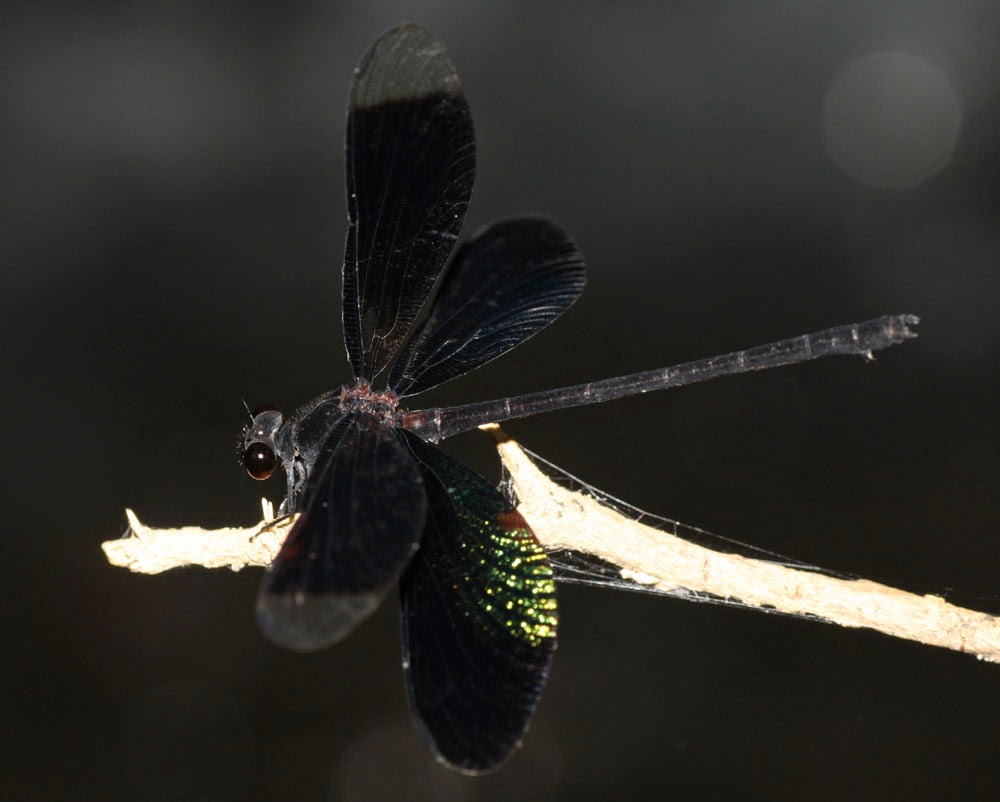
A medium damselfly, this species has dark body and wings in lateral view. The head is black; the thorax of male is dust black, and dark brown with yellow strips markings in female. The legs are short and stout with a row of teeth on front edge of femurs. The wings of male are dark and on upper side and in the sunlight, the hind wings have green/blue flash (the color changes up to position of view) on basal anal area. In female, wings are hyaline with basal orange-yellowish area. Male abdomen is black with a stuff of hairs on lower apical corner of segment tenth in lateral view.


The mature forms do not fly very far from their breeding habitat; they live at clear streams in good forests. The males are not easy recognized in shade but in sunshine they show their hind wings with green metallic flash for territorial and courtship behavior. 

Male with blue hind wing, photographed by Cuong Do, Quang Binh Province

Male with green flash hind wing, photographed by Cuong Do, Quang Binh Province

Blue hind wing male, photographed by Cuong Do, Hon Ba, Khanh Hoa Province


Wednesday, April 16, 2014

Rhinocypha watsoni Tol & Rozendaal, 1995

In 1995, Tol and Rozendaal described this species base on specimens collected from Bach Ma National Park, Thua Thien Hue Province. Recently, this species also were recorded in Khanh Hoa Province and it made their distribution had been known wider to the south of the country.

They are small damselflies, with nearly unicolour body. The head is dull black; the thorax is dark with red dark brown marking and yellow strip marking on lateral side of the synthorax. Legs of male are black, with white inner side tibia of middle legs. In male, fore wings are hyaline but hind wing hyaline with an iridescence area at tip. And in the iridescence area, there is a distinct apical metallic blue flash spot. Females are fader than males with dusk hyaline wings.

This damselfly was found in the centre to south of Vietnam in the forests on high mountains with elevation from 700 to more than 1000m. They are found next to shaded clean streams in pristine forests; usually share their habitat with D. cyanocephala. Particularly we found them in Hon Ba Nature Reserve, Khanh Hoa province as they were flying in the jungle at the coming out area of underground streams.


The damselfly is somehow active species, males usually perch middle or high above that water surface but they do not fly far from breeding sites, where are clean and swift flowing streams.

Male, photographed by Cuong Do, Bach Ma National Park, Thua Thien Hue

Aristocypha fenestrella (Rambur, 1842)

Aristocypha fenestrella is one of the odonate species with wide range of altitudinal distribution (0-1700 m). It is one of several common mountain stream damselflies and widespread species.

They are small glittered damselfly with broad violet wings. The body of male is deep black basically with some yellow stripes on thorax and a particular triangular purple marking on dorsal of synthorax. Head is uncoloured black in both male and female with the swollen clypeus as characteristic of the family. Fore wings are narrow, hyaline and some how brownish and hind wings are much broader, with shining violet cell areas insert into dark background. Wings of female just are hyaline or hyaline-brownish. Legs of mature male are very typical with tibia developed to be broader and white coloured. The colours of teneral males usually are fader than it of mature forms.

Those damselflies usually are found in the primary forests, the mature forms fly around their breeding sites which are clear, swift streams. Although they are forest species, this species is quite common, they are widespread species and could be found in whole of the country.

It is one of the most active species of the family with and males are strict territorial individuals. Each male usually appropriates a micro-habitat (a rock, floating timber or a branch of tree..) near the water surface. And when another male enters his territory, rival flying dance will be observed. In courtship flying dance of male and female, or rival flying dance of males, the male usually stay-flies in the air and shows his flash violet hind wing and white tibia of his legs to the partner. A territorial flying between two males take place from some second to many minutes.

Larvae of the species live in sand, gravel swift streams; they are very typical with two long filament gills at the end of abdomen.

Young male, photographed by Cuong Do, Ba Vi National Park

Mature male in full color, photographed by Cuong Do, Hon Ba, Khanh Hoa

Mature male in full color, photographed by Dang Ngoc Tu, Tu Son, Hoa Binh

Female, photographed by Cuong Do, Hon Ba, Khanh Hoa


Devadatta cyanocephala Hamalainen, Sasamoto & Karube, 2006

In 1995, Jan Van Tol reported about three females of this species in his field trip to Bach Ma National Park, and based on the characteristic of wing venation of females he believed that it is unknown species he did not name it as a new species for science cause of lacking male. Latter Haruki Karube, Akihiko Sasamoto and Matti Hamalainen did the description of this species independently base on males and females of the species that collected from the same locality and Bao Loc Province. Finally, three of them cooperated to publish the description of the species in 2006, 10 years later after Jan Van Tol's report. Name of the species specifies its blue face.

They are medium size damselflies head is typical with brighten cream bluefish marking of their face. Body is black brownish in general with cream yellowish marking on thorax and abdomen, legs short and robust. Wings are hyaline with an apical fate dark spot, they usually fold wings at rest, and they rarely open the wings as resting. They were found in clear streams in tropical forest of Limestone Mountains, in Bach Ma - Thua Thien Hue and recently were recorded in Hon Ba - Khanh Hoa and Lam Dong - Bao Loc. Although they are very common at the habitat sites but they have only been known in the centre and south of Vietnam. They are weak flied damselfly, and do not fly too far from the breeding sites, the mature forms usually fly in shade of the forest but occasionally they can be found near waterfalls, in sunshine.


Male of D. cyanocephala, photographed by Cuong Do in Bach Ma, Thua Thien Hue

Female of D. cyanocephala, photographed by Cuong Do, Bach Ma, Thua Thien Hue


Wednesday, February 19, 2014

Didrepanephorus Wood Mason, 1878

Didrepnaephorus is the most diversity genus among horned rutelinae, there are total 16 known species of the genus.


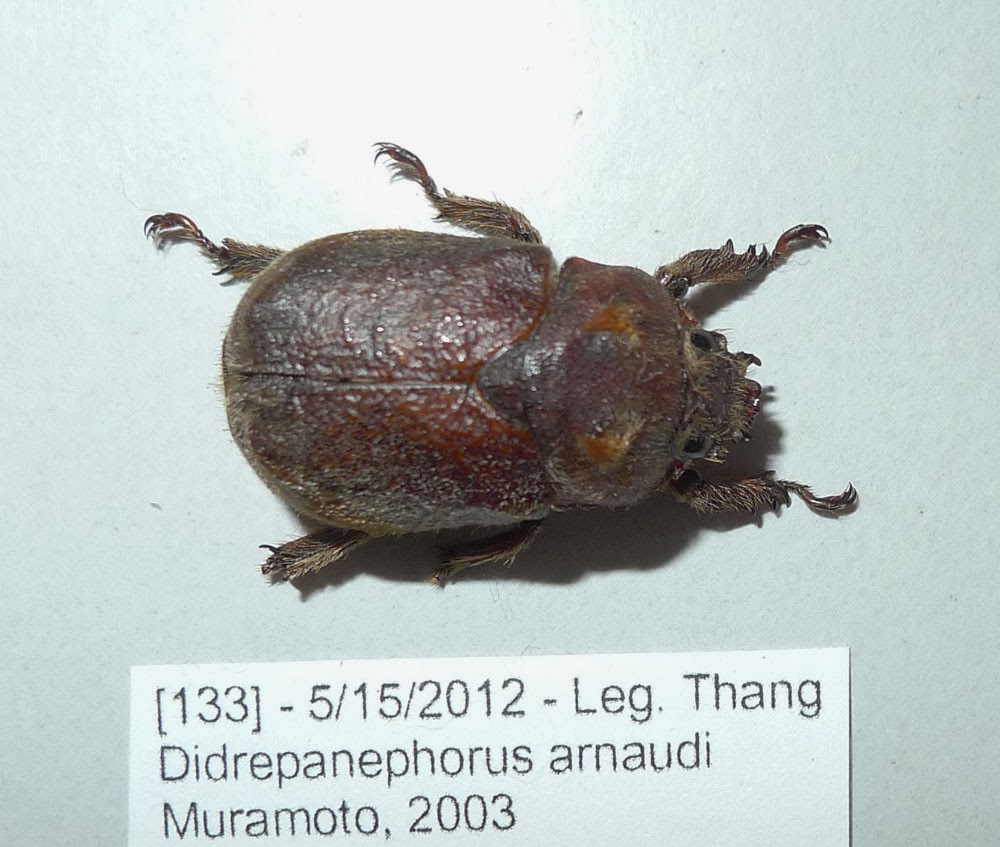
Didrepanephorus arnaudi Muramoto, 2003 found from Kon Tum South Vietnam (Do Collection), characteristic with 2 yellow hair stuffs on pronotum dorsally.

Didrepanephorus bifurcifer Wood-Mason, 1878
Didrepanephorus birmanicus (Arrow, 1907)
Didrepanephorus fukinukii (Muramoto & Araya, 2000)


Didrepanephorus lamdongensis Muramoto, 2013 (paratype in Do Collection), this species is new described from Lam Dong and Khanh Hoa Province, South Vietnam in 2013.

Didrepanephorus lao Nagai, 2005
Didrepanephorus malayanus (Nagai & Hirasawa, 1991)

Didrepanephorus mizunumai Nagai & Hirasawa, 1991 (Do Collection)

Didrepanephorus mucronatus Arrow, 1921
Didrepanephorus nishiyamai Muramoto, 2006
Didrepanephorus ohbayashii (Nagai, 2004)

Didrepanephorus pilosus Bouchard, 2007 (Do Collection), known only from Laos

Didrepanephorus subvittatus Benderitter, 1929


Didrepanephorus takuyai (Muramoto, 2003) an endemic species from South Center of Vietnam.

The species D. yunnanus currently consist of 5 subspecies, however I think they should be upgraded to be species levels because they are quite difference each other base on their structure of male genitalia organ.

Didrepanephorus yunnanus clermonti Benderitter, 1929 (Do Collection)

Didrepanephorus yunnanus kachinensis Muramoto, 2005
Didrepanephorus yunnanus piaoacensis (Nagai, 2004)
Didrepanephorus yunnanus wakaharai (Nagai, 2004)


Didrepanephorus yunnanus yunnannus (Ohaus, 1911) (Do Collection)

Didrepanephorus zen Muramoto, 2009 is known as an endemic species of the center of Vietnam.