Custom Search
Showing posts with label Moth. Show all posts

Friday, February 3, 2017

Milionia zonea zonea Moore, 1872

A species of Geometridae family, in which most of the members are night flying moths, however this species is a day flying moth with colorful wings. They found from India to Japan and South East Asia. There are four subspecies that have been drescribed: Milionia zonea zonea (North East India, Myanmar to Vietnam), Milionia zonea nishiyamai (found in Leyte Island), Milionia zonea pryeri (found in Japan to Taiwan and Hainan China), Milionia zonea sharpei (found from Malaysia, Borneo and Sumatra area).


Milionia zonea zonea Moore, 1872 (Photographer: Tran Quoc Long - long.tranquoc@live.com -  at Da Lat, Lam Dong Province, South Vietnam)


Milionia zonea zonea Moore, 1872 (Video clips by photographer: Tran Quoc Long - long.tranquoc@live.com -  at Da Lat, Lam Dong Province, South Vietnam)


Monday, June 13, 2016

Glanycus insolitus Walker, 1855

Glanycus insolitus Walker, 1855, a member of Leaf Moth Thyrididae, male and female are very difference in color. The male with shining dark blue wings but female wings are red with black and dark blue marking. They are very small moth and close to members of Sphingidae, colorful insects but attracted by a light trap. They are wide distributed insects, the holotype was collected from Bangladesh.

A male of Glanycus insolitus Walker, 1855, photographed by Cuong Do


Tuesday, June 7, 2016

Griseosphinx marchandi Cadiou, 1996

There are 4 known species of Griseosphix and all member of the genus are found in oriental area. The most early described species is Griseosphinx preechari, it was described in 1990 based on materials from Thailand. G. marchandi is second species was new for science in the genus and it was described in 1996, Cadiou published G. marchandi based on a single female holotype that collected from Vietnam. Recently the species was recorded by Le Quynh Trang (Vietnam National Museum of Nature) from Cuc Phuong National Park, Ninh Binh Province. The recently recorded time of the species is April, 2016; it was collected in pristine forest in lowland area of Cuc Phuong. It came to the light trap from 6:00 to 9:00 pm.

Griseosphinx marchandi Cadiou, 1996


Wednesday, May 18, 2016

Loepa diffundata Naumann, Nässig & Löffler, 2008

Loepa diffundata Naumann, Nässig & Löffler, 2008 was changed and described from the subspecies L. katinka diversiocellata. And in the paper, authors also proposed that L. diversiocellata is synonym of L. katinka. Loepa diffundata was recorded in South East Asia and is a wide distributed species.
In Vietnam, the species found in Lam Dong, Thua Thien Hue, Vinh Phuc and Hoang Lien, Lai Chau-Lao Cai. They are active at late after middle night, sometime nearly morning and found in the good forests with elevation about more than 700m.


Loepa diffundata Naumann, Nässig & Löffler, 2008 - phogographed by Cuong Do

Monday, May 16, 2016

Eupanacra busiris busiris (Walker, 1856)

Eupanacra busiris busiris (Walker, 1856) is quite wide distributed species, they found from India to South East Asia and South China. There are 5 subspecies of the species E. busiris be described. Eupanacra busiris atima found only from India; Eupanacra busiris marina found in Andaman Islands (India); Eupanacra busiris myosotis was described from Indonesia and Eupanacra busiris schuetzi found in Philippines. They are plant mimic moths, the whole body marking of the species similar to an orchid trunk. Color of dried specimen very much difference from alive form.


Eupanacra busiris busiris (Walker, 1856) - photographed by Ly Phu Tai


Eupanacra busiris busiris (Walker, 1856) - photographed by Nguyen Ba Quang


Saturday, May 14, 2016

Xyleutes persona Le Guillou, 1841

Species of Xyleutes are large size moths of Cossidae, there are 2 species were recorded from Vietnam:  Xyleutes persona Le Guillou, 1841 and Xyleutes strix (Linnaeus, 1758). Both of the species are wide distribute from India to South East Asia, Papua New Guinea, Xyleutes strix (Linnaeus, 1758) found also in Solomons. In Vietnam, Xyleutes species found in mountain forests with elevation from 700 to more than 1000m. The species Xyleutes persona Le Guillou, 1841 was recorded the first time by Yakolev & Witt in 2009. 2 species of Xyleutes can be easy separated by color of the pronotum: Xyleutes persona with a white pronotum while Xyleutes strix has black part of pronotum in dorsal view.


Xyleutes persona Le Guillou, 1841 - photographed by Cuong Do


Marumba spectabilis (Butler, 1875)

Marumba spectabilis (Butler, 1875) is one of 6 species of Marumba that found from Vietnam: Marumba cristata (Butler, 1875), Marumba dyras (Walker, 1856), Marumba gaschkewitschii (Bremer & Grey, 1853), Marumba saishiuana Okamoto, 1924, Marumba spectabilis (Butler, 1875) and Marumba sperchius (Ménétriés, 1857). The species Marumba spectabilis (Butler, 1875) and Marumba saishiuana Okamoto, 1924 very similar in shape of wings as well as marking on on the wings.


Marumba spectabilis (Butler, 1875) - Photographed by Cuong Do


Marumba spectabilis (Butler, 1875) moving its wings at night


Cypa decolor (Walker, 1856)

There are 2 species of genus Cypa that found from Vietnam, Cypa decolor (Walker, 1856) and Cypa enodis Jordan, 1931. They are very similar and the characteristic to separate them is the hind wings structure. Cypa decolor (Walker, 1856)  found in South of Vietnam while Cypa enodis Jordan, 1931 found in North Center of Vietnam.
Cypa enodis Jordan, 1931 found in both pristine and disturbed forests with elevation from 700 to more than 1000m.


Cypa decolor (Walker, 1856) - photographed by Cuong Do


Friday, May 13, 2016

Cephonodes hylas (Linnaeus, [1771])

Cephonodes hylas (Linnaeus, [1771]) is a wide distribute and common species, they have been recorded from Near East, Middle East, Africa, India, China, Japan, South East Asia and Australia. They are bee mimic moth and day flying insects with hyaline wings are not same to any other members of Sphingidae.
There are 2 species of the genus were found in Vietnam, the second species smaller: Cephonodes picus (Cramer, 1777)


Cephonodes hylas (Linnaeus, [1771]) - photographed by Ly Phu Tai, Bao Lam, Bao Loc, Lam Dong Province

Dahira obliquifascia (Hampson,1910)

Dahira obliquifascia (Hampson,1910) is a wide distribute species of Indochina region, the species found also in South China and South of Thailand as well. This species and Dahira rubiginosa Moore, 1888 are two only members of the genus that were recorded for fauna of the country. Not so common locally, the species found in vary of elevation and also be recorded in disturbed forests.


Dahira obliquifascia (Hampson,1910) - photographed by Cuong Do


Thursday, May 12, 2016

Neogurelca hyas (Walker, 1856)

Neogurelca hyas (Walker, 1856) is wide distributed species however it is not common locally. The species was found from India to Indochina, Japan and Indonesia.
In Vietnam, this species was record in disturbed forests with elevation about 500-700m.


Neogurelca hyas (Walker, 1856) - photographed by Cuong Do


Wednesday, May 11, 2016

Rhodoprasina callantha Jordan, 1929

Rhodoprasina callantha Jordan, 1929 is one of two members of the genus Rhodoprasina that found from Vietnam. The species Rhodoprasina callantha Jordan, 1929 is more common (about Indochina,  Yunnan and Bhutan)  and wide distributed while the other smaller species: Rhodoprasina winbrechlini Brechlin, 1996 is quite rare and found only from North East of Vienam and Yunnan, China.
Despite of  more wide distribute, Rhodoprasina callantha Jordan, 1929 is not common locally, they found in good forests with elevation from 400 to more than 1000m.

Rhodoprasina callantha Jordan, 1929 - photographed by Cuong Do

Saturday, March 26, 2016

Smerinthus szechuanus (Clark, 1938)

The species was described based on materials that collected from China, recently it was recorded also in North Vietnam.

Smerinthus szechuanus (Clark, 1938)


Monday, March 21, 2016

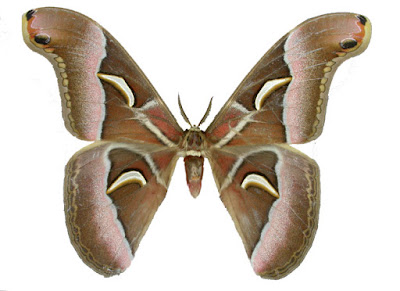
Samia vuvanlieni Naumann, Peigler & Läffle, 2014

A new described species of Saturniidae in 2014, the species is large size moth that found from Bidoup National Park, Lam Dong Province, they also were recorded in Kon Tum and Da Nang Province. The species is largest moth of the genus, two smaller related species are S. watsoni and S. formosana. Mature form found in high elevation habitat, about more than 1500m.


Samia vuvanlieni Naumann, Peigler & Läffle, 2014 - dorsal view of male


Tuesday, March 8, 2016

How to prepare butterfly specimens

A quick guide for preparing butterfly specimens, step by step:
1. Insect specimens as butterflies, moths, dragonflies were collected from the field and keep in dried condition with folded wings and in the butterflies envelope.

2. Before mounting the specimens, we need to relax them and make them flexible wings/body, preparing a plastic box with lid.


3. Preparing a rack that fit on the plastic box, you can find the similar items or just make an rack on your way with stick and some wood pieces. In this case I used a plastic rack.


4. And set the rack into the box


5. Add the room temperature water to the box. DO NOT USE HOT WATER and keep the water lever lower than the upper surface of the rack (keep the rack surface be dried). The hot water with steam as well as wet and sticky surface rack will be reason that the wings of butterflies lose the scales.


6. Release the butterfly from its envelope and carefully put them on the rack.
  

7. You also can keep put the whole envelope with butterfly inside on the rack, however I hate to open wet envelope after that. You also can access several specimens at same time.


8. Close the lid of the plastic box in several hours, time up to how your specimens dried. An overnight duration is an usual standard, in some case it take some days.


9. Check the specimens if they are flexible by an insect forceps. Only begin mounting the butterfly as you sure that the wings can open easily and flexible.


9. Mounting the butterfly with a foam board and insect pins.


10. And compile pinning the specimen, keep them dried in room temperature or you can put them in an incubator but do not set the temperature too high. You also can keep the pined specimens in a box with silica gel or just simple keep them in a dried room.


11. Add data label and keep them in entomological collection box.


Saturday, August 16, 2014

Silkmoth Pupa, a Vietnamese food from insects

The silkworm is the larva or caterpillar of the domesticated silkmoth, Bombyx sp. belong to Bombycidae family, Lepidoptera order. It is an economically important insect of Vietnam in the past as well as now a day, being a primary producer of silk.

Many villages in North Vietnam were famous with raising silkworms and harvesting cocoons, they feed the silkworms with mulberry leaves.

Silkworms are being feed with mulberry leaves

In the silkworms farm, thousand individuals of silkworms are being bred every day

Then they harvest the cocoon of silkworms to make the nature silk

The best quality cocoon are selected for the industry of nature silk

However they don't waste the remain cocoon after selection for silk, the pupa of the cocoon is released

In Vietnam, you can easy to find and buy pupa of silkworm in any local market, and it is one of the most common insect food in Vietnam. It known as a high protein food with very tasty and famous.

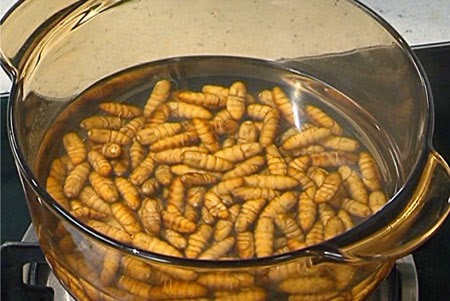
From the market, pupae are washed and quick boiled before being dried up

Lemon leaves were cut into tiny stripes

And the fresh onion leaves as well


The silkmoth pupae will be fried with lemon and onion leaves, sometime they add pepper and chilies. Lemongrass also can be added as an option. Fish sauce never lack as frying silkmoth pupae.


And today, in some Vietnamese families, they can make them with mayonnaise.