Custom Search
Showing posts with label Kon Tum. Show all posts

Monday, March 21, 2016

Samia vuvanlieni Naumann, Peigler & Läffle, 2014

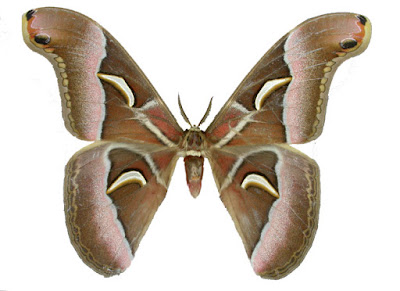
A new described species of Saturniidae in 2014, the species is large size moth that found from Bidoup National Park, Lam Dong Province, they also were recorded in Kon Tum and Da Nang Province. The species is largest moth of the genus, two smaller related species are S. watsoni and S. formosana. Mature form found in high elevation habitat, about more than 1500m.


Samia vuvanlieni Naumann, Peigler & Läffle, 2014 - dorsal view of male


Saturday, February 20, 2016

Aegolipton roubali Komiya, Drumont & Lorenc, 2012

Aegolipton roubali was described based on the materials collected from Vietnam and Laos.
The holotype was collected from Ngoc Linh, Kon Tum Province, South Center of Vietnam in 2010.
In Laos, this speces found in Dackchung and belong to Sekong Province.
Name of species to honor Mr. Viktor Roubal, University of Ulm (Germany)
Whole body of the species is covered with yellow-whitish hairs.

Male of Aegolipton roubali, specimen from Kon Tum Province

Tuesday, July 8, 2014

Endemic species of Lucanus from Vietnam

There are 8 species of Lucanus that known only from Vietnam, they usually collected in good forest mountain areas with elevation over 700m.


2. Lucanus fujitai (from Fujita 2010)

3. Lucanus fukinukae (from Fujita, 2010)

4. Lucanus luci (from original descrption), this species found from Ngoc Linh, Kon Tum Province (South Center of Vietnam) with large populations.

5. Lucanus kraatzi giangae, this species has been found both from Vietnam and China but the subspecies has known as an endemic taxon of Vietnam, found from Cao Bang Province, North Vietnam

6. Lucanus ngheanus (from Fujita, 2010), the specimens of type were collected from Pu Mat, Nghe An Province, however later this species also be found in Ngoc Linh, Kon Tum Province

7. Lucanus persariini (from Fujita, 2010)

My previous post on Lucanus persariini now is considered as Lucanus pulchelus (8) however its situation should be reviewed in the future.

Tuesday, July 1, 2014

Cheirotonus, Long arm beetles from Vietnam

Cheirotonus is a genus of Euchiridae or some author keep them in subfamily of Melolonthidae or subfamily Euchirinae of Scarabaeidae. Their English name is long arm beetle and in Vietnamese, they are called "Cua Bay" with meaning is flying craps, anyway, the name of the genus because of their very long fore legs. In Vietnam there are four species of the genus, three of them with mun-ti spots on the elytra: Cheirotonus battareli, Cheirotonus gestroi and Cheirotonus parryi and the remain with dark green elytra: Cheirotonus jansoni. 

The species Cheirotonus parryi is the first species that named for science of the genus, its name honor to Major Frederick John Sidney Parry who was a British Army Solder and an entomologist of Entomological Society of London and Linnae Society as well. He was an specialist of Coleoptera, particularly Lucanidae. In Vietnam the species Cheirotonus parryi  has been found from Southern Forests: Cat Tien National Park, Dong Nai Province.

Male of Cheirotonus parryi with long medial spine of fore legs.

Two other yellow spotted elytra species is Cheirotonus battareli and Cheirotonus gestroi. The species Cheirotonus battareli have been found only from North Vietnam: Sa Pa (Lao Cai), Van Ban (Yen Bai), Tay Con Linh (Ha Giang), Mau Son (Lang Son), Pia Oac (Cao Bang), Tam Dao (Vinh Phuc), Pu Mat (Nghe An)... and the later species Cheirotonus gestroi maybe distributes in South Center of Vietnam: Kon Tum, Quang Nam, Quang Ngai, Lam Dong. They are very similar each other but difference from Cheirotonus parryi in the medial spine of fore legs (shorter). In Cheirotonus gestroi, the lobe of medial spine of fore femur without teeth but there are some teeth on it of Cheirotonus battareli. 

 
Male of Cheirotonus battareli

Male of Cheirotonus gestroi

In 1994, Muramoto published a paper with description of Cheirotonus fujiokai from China, near Vietnam border (Ha Giang Province). The question if Cheirotonus fujiokai can be found from Vietnam has not been answered, however this small size species very similar to Cheirotonus gestroi but difference from both Cheirotonus gestroi and Cheirotonus battareli in medio-lateral shallows depression of pronotum of male: in Cheirotonus fujiokai, the area just finely punctured but it is deeply punctured in two previous species. 

Male of Cheirotonus fujiokai (from original description)

Male of Cheirotonus jansoni
Sunday, June 15, 2014

Rhaetulus maii Maeda, 2009 and Dorcus cuongi Maeda, 2009

In 2009, Mr. Takeshi Maeda published a paper in which three new species of Lucanidae were described: Lucanus dongi, Rhaetulus maii and Dorcus cuongi.

All specimens of three species were collected from Kon Tum Province (misspelling as Contum in the paper) in 2008 by Mr. Nguyen The Dong, an insect catcher who lives in Tam Dao Town. The species Lucanus dongi and Dorcus cuongi has been confirmed of another locality in Quang Nam Province (in two year: 2013, 2014) while Rhaetulus maii has not been recorded from anywhere else except the locality of type series (Kon Tum Province).


Since three species was published, none of them has been recorded again or rediscovered from the locality of type specimens (Kon Tum Province), and the question about the true locality of the type specimens is still a mystery of science. However, they maybe all are endemic species of Vietnamese fauna.

There is an interesting story about the name of three species, they were name after members of Mr. Nguyen The Dong's family: Nguyen The Mai is Mr. Nguyen The Dong's father and Nguyen The Cuong is name of his son. "Mai", "Dong" and "Cuong" in Vietnamese are their fist name and they all belong to Nguyen family.

Takeshi Maeda is a Japanese entomologist and insect collector who had worked a long time in Vietnam, he also has a long previous co-working with Mr. Nguyen The Dong on Vietnamese stag beetle fauna. He can speak Vietnamese quite well. Now, he is working mainly in India-Myanmar fauna.


Type of series specimens of Rhaetulus maii (scan from the original description)

Type of series specimens of Dorcus cuongi (scan from the original description)

Thursday, April 10, 2014

Lucanus dongi Maeda, 2009

One of the most important discovery of Lucanidae recently is the paper by Maeda in 2009 with a series of new and rare species of this group from South Vietnam. One of them is Lucanus dongi Maeda, 2009. The species is typical with a lower apical tooth that flatten, not point and two posterior lobes of head are developed remarkably.

Takeshi Maeda in an entomologist and collector from Japan, he worked mainly in Vietnam about more than 10 years ago, can speak Vietnamese very well, he helped many Japanese entomologists get the materials from Vietnam for studying in a long time. Not same to Mr. Katsura, only collecting, Mr. Maeda done some works on taxonomy of Lucanidae from Vietnam. He co-worked with Mr. Dong, who is a local collector from Tam Dao, and one of the local collector can identify the insect groups. Mr. Dong can't speak English, can't read manuscript and know nothing about taxonomy but he collected insect in very early time. His knowledge about biology as well as ecology of insects from Vietnam makes any specialists be surprised. About 5 to 10 years ago, he is maybe only the Vietnamese who understand about species of Lucanidae in Vietnam, who can recognized undescribed species of the fauna. Name of the species was named after Mr. Dong who first person recognized the species was unknown species, but Mr. Maeda make the description of the paper.

The type locality of L. dongi that recorded in the paper is Kon Tum, South Vietnam, however since it found in 2009, no more record of the species in Kon Tum be confirmed again, so the question about the true type locality of Lucanus dongi has not been full cleared.

Dorsal view of large male of Lucanus dongi

Lateral view of Lucanus dongi

Head and mandible of Lucanus dongi


Wednesday, April 9, 2014

Yumikoi makii Arnaud & Miyaa, 2006

This species is known as an endemic species that found from center of Vietnam. It distributes from Thua Thien Hue to Quang Nam and Quang Ngai Provices, maybe also found in Kon Tum. It is monotype of the genus Yumikhoi, authors erected the species and the genus in the same paper in 2006.

It is one of the species that easy to breed so it is object of many breeders.

The species be found in forests with elevation from 700 to more than 1000m, of Truong Son Mountain Rage in center of Vietnam. The female is black and much more smaller than the male.

Dorsal view of male specimen

Male in front view


Wednesday, February 19, 2014

Didrepanephorus Wood Mason, 1878

Didrepnaephorus is the most diversity genus among horned rutelinae, there are total 16 known species of the genus.


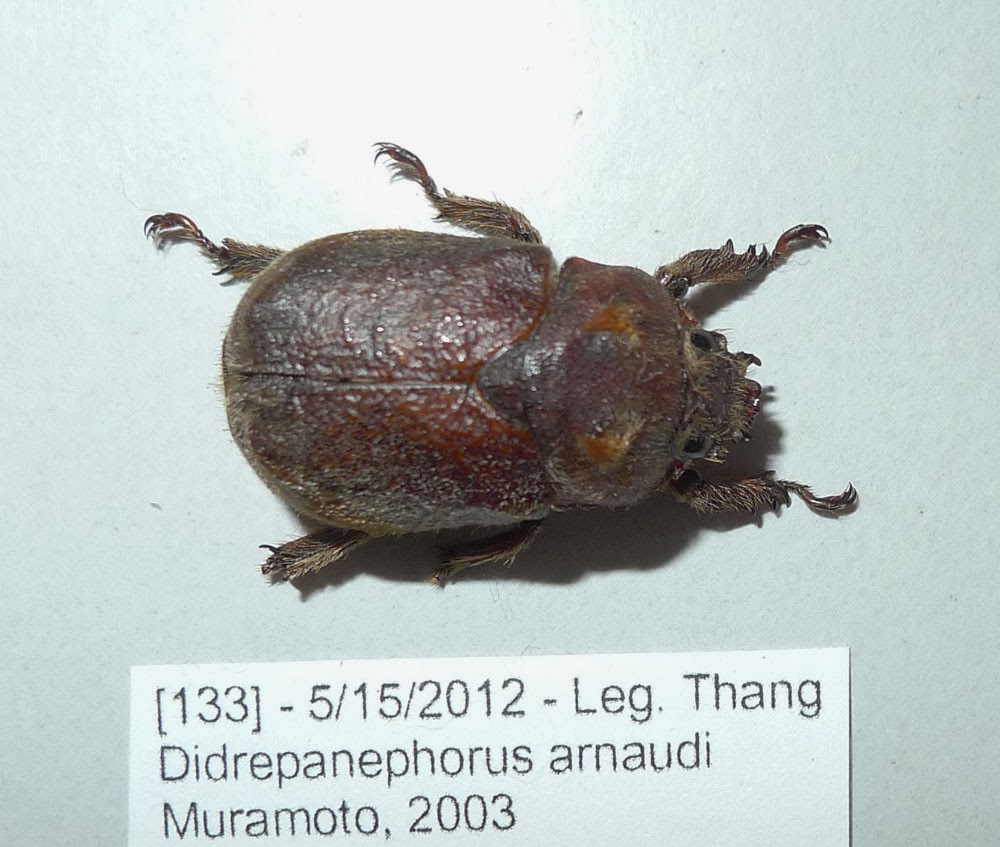
Didrepanephorus arnaudi Muramoto, 2003 found from Kon Tum South Vietnam (Do Collection), characteristic with 2 yellow hair stuffs on pronotum dorsally.

Didrepanephorus bifurcifer Wood-Mason, 1878
Didrepanephorus birmanicus (Arrow, 1907)
Didrepanephorus fukinukii (Muramoto & Araya, 2000)


Didrepanephorus lamdongensis Muramoto, 2013 (paratype in Do Collection), this species is new described from Lam Dong and Khanh Hoa Province, South Vietnam in 2013.

Didrepanephorus lao Nagai, 2005
Didrepanephorus malayanus (Nagai & Hirasawa, 1991)

Didrepanephorus mizunumai Nagai & Hirasawa, 1991 (Do Collection)

Didrepanephorus mucronatus Arrow, 1921
Didrepanephorus nishiyamai Muramoto, 2006
Didrepanephorus ohbayashii (Nagai, 2004)

Didrepanephorus pilosus Bouchard, 2007 (Do Collection), known only from Laos

Didrepanephorus subvittatus Benderitter, 1929


Didrepanephorus takuyai (Muramoto, 2003) an endemic species from South Center of Vietnam.

The species D. yunnanus currently consist of 5 subspecies, however I think they should be upgraded to be species levels because they are quite difference each other base on their structure of male genitalia organ.

Didrepanephorus yunnanus clermonti Benderitter, 1929 (Do Collection)

Didrepanephorus yunnanus kachinensis Muramoto, 2005
Didrepanephorus yunnanus piaoacensis (Nagai, 2004)
Didrepanephorus yunnanus wakaharai (Nagai, 2004)


Didrepanephorus yunnanus yunnannus (Ohaus, 1911) (Do Collection)

Didrepanephorus zen Muramoto, 2009 is known as an endemic species of the center of Vietnam.