Custom Search
Showing posts with label Rutelinae. Show all posts

Tuesday, March 22, 2016

Pukupuku katsurai (Muramoto, 2002)

The species was described by Mr. Masayuki Fujioka under his wife's name Mrs. Rieko Muramoto in 2002. In the original description, the new species belong to Fruhstorferia genus, however the author then erected a new genus and moved two related species Frustorferia curta and F. katsurai to Pukupuku.
The species was named after Mr. Katsura who collected insects from Vietnam in many years, he married a Vietnamese girl, her name is Doan Lan Giang.
Pukupuku katsurai is a very particular species and the mature form flies in a short duration of beginning of spring in North Vietnam so it is quite rare. The species recently also found from South China.
In Vietnam, only a locality was recorded as the habitat of the species, the pristine forest, Pia Oac Nature Reserve, Cao Bang Province, North Vietnam where also is type locality of the species.

Pukupuku katsurai (Muramoto, 2002) - Male in dorsal view


Pukupuku katsurai (Muramoto, 2002) - Male in lateral view


Thursday, July 3, 2014

How to access the male genitalia of a scarab beetle for studying in the laboratory

Genitalia analyze is one of very important step of studying taxonomy of insects in general and beetles particularly. Not only because they are very variable in mature form but also they are very similar among individuals that not belong same species. For some group of beetles, genitalia is not the key characteristic for separate species but in some group, the male genitalia is only way to identify them to species level.

Each taxonomist developed himself a way to study his group, this posting I am going to express how I access the male genitalia of a horned rutelinae for studying without cut them off from the specimen.

Prepare a hot water cup/box for the dried specimen that collected from the field. 


 Keep the male beetle into the hot water, duration up to how dried specimen is and with hotter water, the specimen will be flexible in a shorter time (do not reboil water with the beetle in because too high temperature will destroys the pigment chemical agents (color).

From left to right (below): box of hot water (now maybe warm water) with beetle specimen, soft tissue paper (toilet paper, don't apply an used toilet paper in this case, we need a clean one), foam board; above: forceps and insect pins.


Make the beetle dried by soft tissue paper, both side of the specimen.

Transfer to the foam board for fix the poission


Fixed specimen with entomological pins then you can access the last abdomen segment without moving

Prepare 2 forceps with point tips, each hand with each one.

 Transfer the beetle to a microscope and see detail the last segment of the abdomen.


Use the point forceps open the last segment

Then you can see the apex of the penis


Then try to pull out the penis from the abdomen


Do it slowly without damage the penis apex (it very sensitive and easy to be broken)


Release specimen by removing the insect pins


Open the mandible make them separate in a good view poisition


Turn the specimen to express position


Fix the specimen in dorsal position with insect pins again.


Under microscopic field, check the shape and position of the genitalia in dorsal view. Shape of the genitalia shows that it look like Kibakoganea dohertyi

Dried fixed specimen in a box with silica-gel in side

As your specimen full dried up, it will ready for pinning or gluing on the card board, do not forget the data label of the specimen. 

Sunday, June 29, 2014

Checklist of Rutelinae, Scarabaeidae of Vietnam

  1. Adoretosoma chromaticum Fairmaire, 1886
  2. Adoretosoma elegans Blanchard, 1851
  3. Adoretosoma nigripenne Ohaus, 1905
  4. Adoretus (Chaetadoretus) alocopygus Ohaus, 1914
  5. Adoretus (Chaetadoretus) kulzeri (Frey, 1970)
  6. Adoretus (Chaetadoretus) vitalisi Ohaus, 1930
  7. Adoretus (Lepadoretus) fuscoseriatus Ohaus, 1914
  8. Adoretus (Lepadoretus) griseosetosus Nonfried, 1891
  9. Adoretus (Lepadoretus) popei (Frey, 1970)
  10. Adoretus (probably s. str.) baquari Abdullah & Roohi, 1968
  11. Adoretus (s str) cochinchinensis (Ohaus, 1914)
  12. Adoretus (s str) convexus Burmeister, 1855
  13. Adoretus (s str) dilleri Frey, 1970, EAM Frey, 1970
  14. Adoretus (s str) fruhstorferi Ohaus, 1905
  15. Adoretus (s str) hanoiensis Frey, 1972, EAM Frey, 1972
  16. Adoretus (s str) kulzeri Frey, 1967
  17. Adoretus (s str) lajoyi Ohaus, 1914, DEZ: 491
  18. Adoretus (s str) langsonicus Paulian, 1959
  19. Adoretus (s str) luridus Blanchard, 1851 (1850)
  20. Adoretus (s str) minutus Brenske, 1893
  21. Adoretus (s str) rosettae Frey, 1970, EAM Frey, 1970
  22. Adoretus (s str) saigonensis Ohaus, 1914, DEZ: 479
  23. Adoretus (s str) sincerus Benderitter, 1929
  24. Adoretus (s str) tonkinensis (Ohaus, 1914)
  25. Adoretus (s str) vietnamensis Frey, 1970
  26. Anomala acutangula Ohaus, 1914
  27. Anomala ahrensi Zorn, ZR-2011
  28. Anomala amychodes Ohaus, 1914
  29. Anomala anchoralis Lansberge, 1879
  30. Anomala atriventris Zorn, ZR-2011
  31. Anomala bilunata Fairmaire, 1888
  32. Anomala bivirgulata Fairmaire, 1893
  33. Anomala blaisei Ohaus, 1914
  34. Anomala cantorioides Paulian, 1959
  35. Anomala castelnaui Ohaus, 1910
  36. Anomala cognata Zorn, ZR-2011
  37. Anomala curator Benderitter, 1929
  38. Anomala dalatensis Frey, 1971
  39. Anomala densa Arrow, 1917
  40. Anomala edentula Ohaus, 1925
  41. Anomala flavofasciata Arrow, 1912
  42. Anomala flavoguttata Miyake, 2000
  43. Anomala fuscosignata Ohaus, 1905
  44. Anomala graminea Ohaus, 1905
  45. Anomala gressitti Frey, 1970
  46. Anomala hirsutula Nonfried, 1892
  47. Anomala holcoptera Fairmaire, 1889
  48. Anomala imperialis Arrow, 1899
  49. Anomala irideorufa Fairmaire, 1893
  50. Anomala iridicollis Ohaus, 1914
  51. Anomala itoi Miyake, 1994
  52. Anomala jeanvoinei Benderitter, 1929
  53. Anomala katsurai Miyake, 1996
  54. Anomala kintaroi Miyake, 1996 (new name for babai Miyake, 1994)
  55. Anomala langbianensis Zorn, 2011
  56. Anomala luminosa Benderitter, 1929
  57. Anomala malaisei Paulian, 1959
  58. Anomala mausonica Zoen, 2011
  59. Anomala millingeni Paulian, 1959
  60. Anomala nervulata Paulian, 1959
  61. Anomala nigroscutellata Benderitter, 1929
  62. Anomala nubeculosa Ohaus, 1905
  63. Anomala ovalis Burmeister, 1844
  64. Anomala parallela Benderitter, 1929
  65. Anomala planelytra Paulian, 1959
  66. Anomala platypyga Fairmaire, 1893
  67. Anomala praeclara Paulian, 1959
  68. Anomala praecoxalis Ohaus, 1914
  69. Anomala punctulicollis Fairmaire, 1893
  70. Anomala raui Ohaus, 1914
  71. Anomala rotundata Paulian, 1959
  72. Anomala russiventris Fairmaire, 1893
  73. Anomala sapa Miyake, 1994
  74. Anomala siamensis Nonfried, 1891
  75. Anomala sinica Arrow, 1915
  76. Anomala spilopteroides Ohaus, 1914
  77. Anomala trillesi Paulian, 1959
  78. Anomala truncata ssp. chlorochelys Arrow, 1912
  79. Anomala vaga Benderitter, 1929
  80. Anomala vietnamica Miyake, 1996
  81. Anomala viridimicans Benderitter, 1929
  82. Anomala viridisericea Ohaus, 1905
  83. Anomala vitalisi Ohaus, 1914
  84. Anomalacra clypealis (Schaefer, 1907)
  85. Callistethus glandulicollis (Ohaus, 1914)
  86. Callistethus metallicus (Benderitter, 1923)
  87. Callistethus nuptus (Ohaus, 1905)
  88. Callistethus rosetti (Nonfried, 1890)
  89. Dicaulocephalus antilocapra Bezdek & Pacholàtko, 2001
  90. Dicaulocephalus fruhstorferi Felsche, 1901
  91. Dicaulocephalus lamdongensis Muramoto, 2013
  92. Didrepanephorus arnaudi Muramoto, 2003
  93. Didrepanephorus mizunumai Nagai et H. Hirasawa, 1991
  94. Didrepanephorus subvittatus Benderitter, 1929
  95. Didrepanephorus takuyai (Muramoto, 2003)
  96. Didrepanephorus yunnanus ssp. clermonti Benderitter, 1929
  97. Didrepanephorus yunnanus ssp. piaoacensis (Nagai, 2004)
  98. Didrepanephorus zen Muramoto, 2009
  99. Fruhstorferia anthracina Ohaus, 1903
  100. Fruhstorferia egregia Pouillaude, 1915
  101. Glenopopillia nagaii (Sabatinelli, 1997)
  102. Kibakoganea canhcamsung Do, 2013
  103. Kibakoganea fujiokai Miyake & Muramoto, 1992
  104. Kibakoganea fujiokai ssp. itohi Muramoto, 2005
  105. Kibakoganea kraatzi Miyake et Muramoto, 2003
  106. Kibakoganea opaca Muramoto, 1993
  107. Kibakoganea sexmaculata (Kraatz, 1900)
  108. Kibakoganea tamdaoensis Miyake & Muramoto, 1992
  109. Kibakoganea vernicata (Benderitter, 1929)
  110. Kibakoganea vernicata ssp. iwasei Muramoto, 1997
  111. Lutera nigromaculata Ohaus, 1900
  112. Mimela abdominalis Ohaus, 1902
  113. Mimela bidentata Lin, 1966
  114. Mimela coxalis Ohaus, 1902
  115. Mimela chinensis Kirby, 1823
  116. Mimela deretzi Paulian, 1959
  117. Mimela despumata Ohaus, 1915
  118. Mimela epipleurica Ohaus, 1930
  119. Mimela foveola Benderitter, 1929
  120. Mimela fruhstorferi Ohaus, 1902
  121. Mimela heterochropus Blanchard, 1851 (1850)
  122. Mimela ignistriata Lin, 1990
  123. Mimela nigritarsis Lin, 1990
  124. Mimela ngoclinhensis Huong & Wada, 2006
  125. Mimela opalina Ohaus, 1902
  126. Mimela signaticollis Ohaus, 1902
  127. Mimela specularis Ohaus, 1902
  128. Mimela xanthorrhoea Ohaus, 1902
  129. Parastasia birmana Arrow, 1899
  130. Parastasia dalatina Kuijiten, 1992
  131. Parastasia hitomi Wada, 1999
  132. Parastasia indica Ohaus, 1898
  133. Parastasia oberthueri Ohaus, 1900
  134. Parastasia rufopicta Westwood, 1842
  135. Parastasia sawadai Wada, 2003
  136. Parastasia vietnamensis Wada, 2008
  137. Peperonota vitalisi Arrow, 1921
  138. Popillia amabilis Arrow, 1913
  139. Popillia flavofasciata Kraatz, 1892
  140. Popillia laevicollis Kraatz, 1892 (homonym of laevicollis Kraatz, p. 229)
  141. Popillia ricchiardii Sabatinelli, 1996
  142. Popillia uhligi Sabatinelli, 1996
  143. Pseudosinghala callosa (Fairmaire, 1888)
  144. Pseudosinghala transversa (Burmeister, 1855)
  145. Pukupuku katsurai (Muramoto, 2002)
  146. Phyllopertha carinicollis Ohaus, 1905
  147. Rutelarcha bakeri Ohaus, 1915
  148. Spilopopillia tonkinensis Ohaus, 1908
  149. Spinanomala benderitteri Burgeon, 1932
  150. Trichanomala fossulata (Benderitter, 1929)

Tuesday, February 25, 2014

Kibakoganea Nagai, 1984

The genus Kikobaganea was erected by Nagai in 1984 as subgenus of Fruhstoferia, Hirasawa promoted it to genus level in 1992. Their typical characteristic is the inner lobe on basal lateral edge of each pronotum side. There are total 14 known species around South East Asia and South China. And they belong to 3 groups (based on structure of the male genitalia organ):


Group 1 with very short and apex separated parameres:

K. formosana (Kurosawa & Kobayashi, 1975) (Do Collection)

This species is endemic in Taiwan, they are quite smaller than other member of the genus, they are green/yellow with black part marking beetles.


K. sinica Bouchard


K. kraatzi Miyake & Muramoto, 2003

This first known from Vietnam then later found from South China and Hainan, the species had been misidentified with K. sexmaculata in a long time but later be described as a new species.


K. opaca Muramoto, 1993 (Do Collection)

This species found from China and recently be recorded from North Vietnam.


Group 2 with longer and not separated parameres which are asymmetrical:


K. kawaii Muramoto, 2005


K. koyamai (Hirasawa, 1989) (Do Collection)


K. kumei (Hirasawa, 1989) (Do Collection)

Last group, group 3, genitalia with not separated and symmetrical parameres:


K. dohertyi (Ohaus, 1905)


K. fujiokai Miyake & Muramoto, 1992 (Do Collection) - Male

Male of K. fujiokai, photographed by Cuong Do, Lam Dong Province


K. fujiokai Miyake & Muramoto, 1992 Female, laying her egg in breeding box. Specimens collected from Lam Dong Privnce


K. sexmaculata (Kraatz, 1900) (Do Collection)
This species is the most early known species among members of the genus. It was first recorded from North Vietnam then be found wider distribute in the area later. The type locality of the species is same to K. kraatzi

K. tamdaoensis Miyake & Muramoto

K. vernicata (Benderitter)

K. canhcamsung Do, 2013 (male holotype) from Tay Giang, Quang Nam Province

K. yoshitomii Nagai

Wednesday, February 19, 2014

Didrepanephorus Wood Mason, 1878

Didrepnaephorus is the most diversity genus among horned rutelinae, there are total 16 known species of the genus.


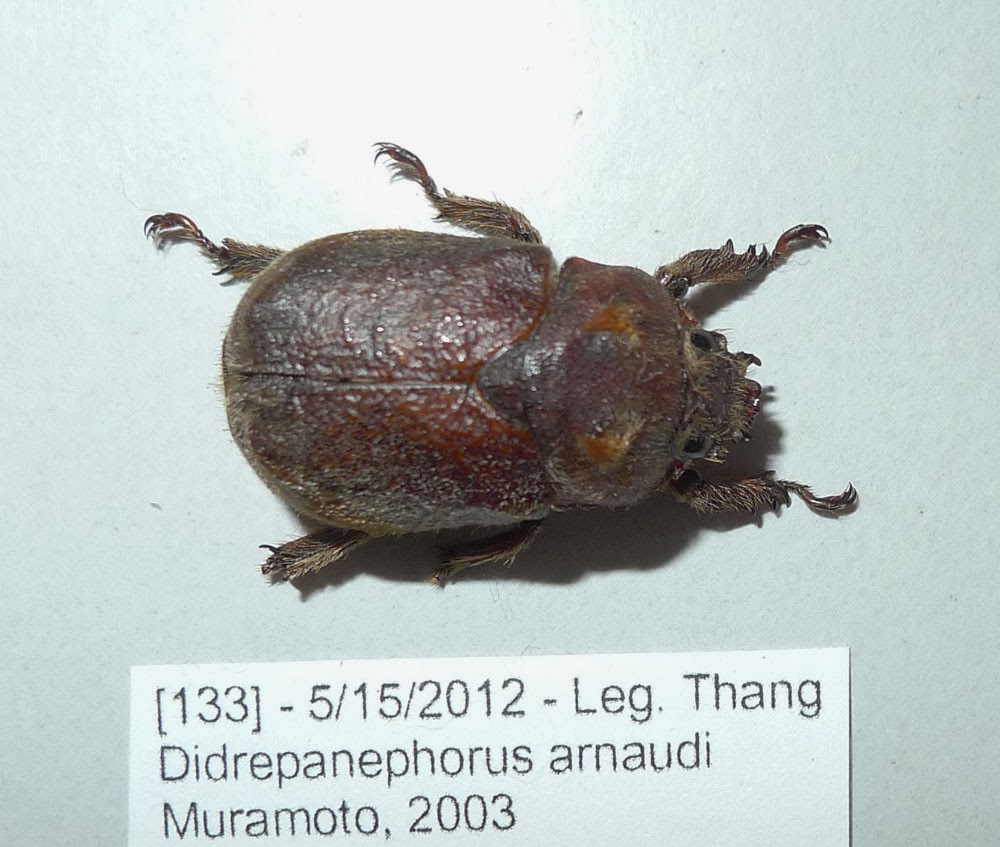
Didrepanephorus arnaudi Muramoto, 2003 found from Kon Tum South Vietnam (Do Collection), characteristic with 2 yellow hair stuffs on pronotum dorsally.

Didrepanephorus bifurcifer Wood-Mason, 1878
Didrepanephorus birmanicus (Arrow, 1907)
Didrepanephorus fukinukii (Muramoto & Araya, 2000)


Didrepanephorus lamdongensis Muramoto, 2013 (paratype in Do Collection), this species is new described from Lam Dong and Khanh Hoa Province, South Vietnam in 2013.

Didrepanephorus lao Nagai, 2005
Didrepanephorus malayanus (Nagai & Hirasawa, 1991)

Didrepanephorus mizunumai Nagai & Hirasawa, 1991 (Do Collection)

Didrepanephorus mucronatus Arrow, 1921
Didrepanephorus nishiyamai Muramoto, 2006
Didrepanephorus ohbayashii (Nagai, 2004)

Didrepanephorus pilosus Bouchard, 2007 (Do Collection), known only from Laos

Didrepanephorus subvittatus Benderitter, 1929


Didrepanephorus takuyai (Muramoto, 2003) an endemic species from South Center of Vietnam.

The species D. yunnanus currently consist of 5 subspecies, however I think they should be upgraded to be species levels because they are quite difference each other base on their structure of male genitalia organ.

Didrepanephorus yunnanus clermonti Benderitter, 1929 (Do Collection)

Didrepanephorus yunnanus kachinensis Muramoto, 2005
Didrepanephorus yunnanus piaoacensis (Nagai, 2004)
Didrepanephorus yunnanus wakaharai (Nagai, 2004)


Didrepanephorus yunnanus yunnannus (Ohaus, 1911) (Do Collection)

Didrepanephorus zen Muramoto, 2009 is known as an endemic species of the center of Vietnam.