Custom Search
Showing posts with label Euphaeidae. Show all posts

Friday, April 18, 2014

Dysphaea gloriosa Fraser, 1938

They are similar in the size of D. basitincta, the body robust built and more colourful. Males of the species are deep black with dark orange marking on the thorax and the abdomen. The wings are narrow and long, their colour is amber hyaline and make the wings are brighten in sunlight. The wings usually are folded at rest; particularly they are sometime open as perching above the water. The females are less colourful than the males with their wings are more hyaline.
                               

Their habitats are similar to those of D. bastitincta but D. gloriosa is much more widespread in the country. They have been found at streams or rivers in open secondary forests or lowland areas. They do not live far from their breeding habitats and usually perch on vegetations around streams.

Male, photo taken by Cuong Do, Hoa Binh

Dysphaea basitincta Martin, 1904

This species was described by R. Martin in 1904 base on specimens collected from Tonkin, Vietnam.

They are medium-large sized damselflies and the heavy body is unicolour shining black. Their elongate wings are dark at haft base and tip.


They live in open opaque rivers with mud and sand bottom layer; the males are active and highly territorial. They fold their wing at rest but many times the clap or open the wings under strong sunlight above the water surface. Mostly the damselflies fly not far from their breeding habitats but some time they fly very high and perch high above on vegetation beside the rivers. 

Male, photographed by Cuong Do, Mai Chau, Hoa Binh

Euphaea masoni Selys, 1879

This species is close to E. guerini and E. hirita, three species are very similar in external structure generally. The damselflies had been mixed with E. guerini as same species but now there are many evidences show that they are three distinct species. 

Similar to its two sister species, they are medium damselflies with dark colours of body and wing generally. The mainly typical characteristic of male individuals of this species is the abdomen without hair or hair stuffs in lateral view. Beside, in dorsal view or upper side of the wings of male, in sunshine and as they open their wings, the hind-wings show its iridescent red flash. Their females are not very special recognized by morphological characteristics with hyaline wings and black body with yellow-greenish markings.


This species somehow is more widespread than the others and have been found over the whole of the country. They live in clear, swift and hemi-shade streams in both disturbed and primary forests. Males protect their territory by fighting and showing their red flash hind-wings and mate with coming females, the later behaviour also use in their courtship. The females are less active and usually perch higher positions.

Male with red flash wings, photographed by Cuong Do, Phu Yen Province

Close up to the face of the male, photographed by Cuong Do, Phu Yen Province

Male with wings are close, showing the blue color of underside, photographed by Cuong Do, Quang Binh Provicne

Under the sunshine, above stream, the male look very colorful with his red wings, photographed by Cuong Do, Quang Binh Province


Euphaea guerini Rambur, 1842

Formerly, together with E. masoni, this species was known as subspecies taxon level but now it is believed to belong into a distinct species. Tol 1995, proposed distributional evident of them in Vietnam and in his papers two species were separated in geography. However two species have been reported at the same stream of a secondary forest in Quang Binh Province so they must be also distinguished in ecology and behaviors.

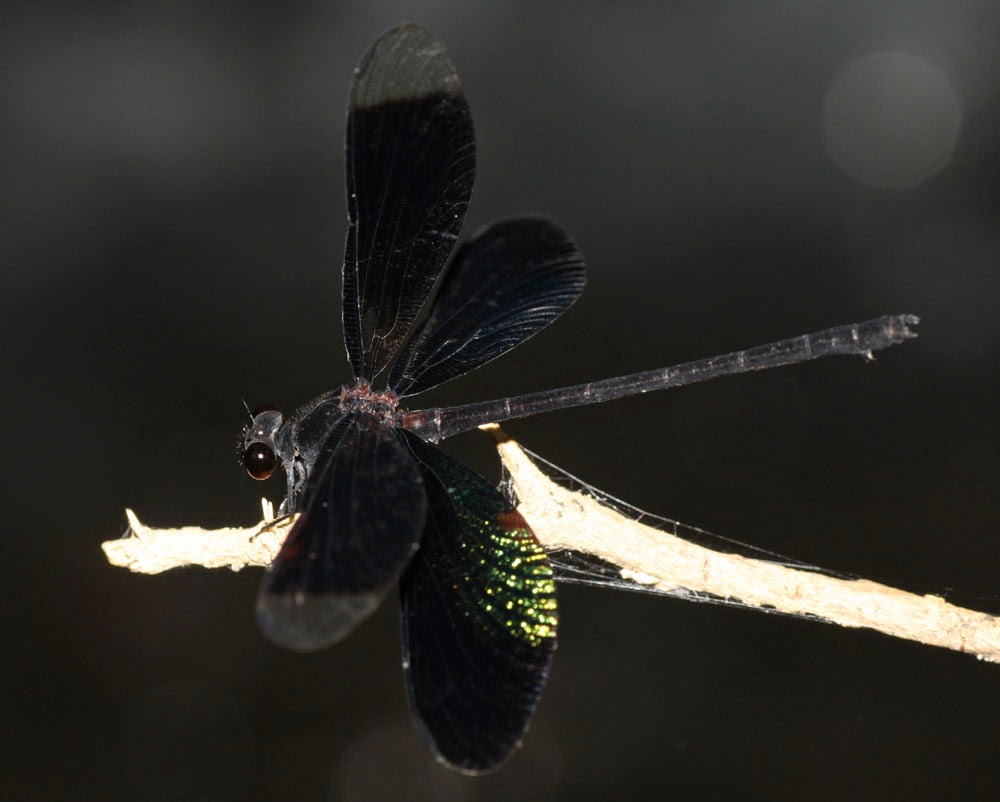
A medium damselfly, this species has dark body and wings in lateral view. The head is black; the thorax of male is dust black, and dark brown with yellow strips markings in female. The legs are short and stout with a row of teeth on front edge of femurs. The wings of male are dark and on upper side and in the sunlight, the hind wings have green/blue flash (the color changes up to position of view) on basal anal area. In female, wings are hyaline with basal orange-yellowish area. Male abdomen is black with a stuff of hairs on lower apical corner of segment tenth in lateral view.


The mature forms do not fly very far from their breeding habitat; they live at clear streams in good forests. The males are not easy recognized in shade but in sunshine they show their hind wings with green metallic flash for territorial and courtship behavior. 

Male with blue hind wing, photographed by Cuong Do, Quang Binh Province

Male with green flash hind wing, photographed by Cuong Do, Quang Binh Province

Blue hind wing male, photographed by Cuong Do, Hon Ba, Khanh Hoa Province


Euphaea decorata Hagen in Selys, 1853

Medium sized damselfly, the mature form flies during rain season, they have been known as a common species in South East Asia. The teneral form has black synthorax marking with dusk yellow marking but it change into dull black in mature form. The fore-wings of male are hyaline and its hind-wings are hyaline with black spot at 1/3 apex. In female, wings are brownish hyaline.


They found at running clean streams in dark or open forests, they usually perch on stones just above water surface or branch of trees 1-3 m above water level. As perching, they some time open or clap the wings (both pair of wings or just hind wings) in sunshine. The males usually fight each other for protecting their territory and mate with coming females which often rest at higher above.

Male, photo by Cuong Do, Ba Vi National Park

Male in opened wings position, photographed by Cuong Do, Tam Dao National Park

 Male, photographed by Cuong Do, Tam Dao National Park


Cryptophaea vietnamensis (Tol & Rozendaal, 1995)

In 1995, Tol found this species in Vu Quang National Park, the centre of Vietnam and named it Babaydera vietnamica. In the description, Tol only described the male, without knowing of female. Some years later, Wilson and Reel  found both male and female in China and they did the description of female of the species. In his paper, the species was revised and changed to Schmidtiphaea genus. Hamalainen based on his study of holotype of Schmidtiphaea and specimen of vietnamica, he erected the new genus Cryptophaea from Schmidtiphaea and moved vietnamica into it. The genus was named after Christophe Columbus in looking back on his discovery of unknown continent, America.
They are medium-small size insects; and not like the male, the female of C. vietnamica is very colourful; she has orange marking on the body with remarkable big marking on her thorax. The male is very simple in colour, with dull dark blue-violet marking on the body. In teneral form, the male are black with cream green marking. They wings are hyaline with somehow petiolate at base.

They live at clear swift streams in pristine forests of limestone mountain. Females of the species usually perch about 1.5 to 2 metres above water while males fly in the nearby forests. In rain season, the female is more common than the male.


Male, photographed by Cuong Do, Tam Dao National Park

Young male, photographed by Cuong Do, Tam Dao National Park

Female with orange marking thorax, photographed by Cuong Do, Tam Dao National Park