Custom Search
Showing posts with label Quang Binh. Show all posts

Tuesday, June 3, 2014

Aeshnidae, Royal dragonfly family

Insects of the family are large to very large sized dragonflies and the number of member of known species reach to over 400 worldwide. The head with two large compose eyes, which are usually brighten green or blue in life, touching together as a line, the labia with weak permental cleft. The thorax is healthy and strong, often green or blue coloured with yellow marking. The wings are usually hyaline but in some species, they are suffused with smoky ochreous colour. Wings of males are, in many species, angulated at the base, the triangles of fore and hind wing are homologous, the 1A vein is pectinate basally. Their abdomen is long and commonly coloured marking. There usually are auricles on both lateral sides of the segment 2 and constricted at the segment 3 of the abdomen. The anal appendages are often long with fasten inferiors. The females possess well developed ovipositors with which they insert their eggs into plant tissue, moss on wet rocks, debris or tree trunks. Many species of the family are crepuscular or even partly nocturnal and some of them are attracted by the lights at night. Larvae are elongate and smooth with their labia long and flat; and they spend their time climbing among the jungle of water plants. They are found in stranding waters, backwaters of running streams or marshy waters with dead leaf layers.


Anax immaculifrons Rambur, 1842 photographed by Cuong Do, Bach Ma National Park, Thua Thien Hue

Polycantha erythromelas (McLachlan, 1896), the female is laying her eggs, hotographed by Cuong Do, Tam Dao National Park

Tetracanthagyna waterhousei McLachlan, 1898, male in dorsal view, photographed by Cuong Do, Quang Binh Province

Tetracanthagyna waterhousei McLachlan, 1898, male in lateral view, photographed by Cuong Do, Quang Binh Province

Tetracanthagyna waterhousei McLachlan, 1898, close up of male anal appendages in dorsal view, photographed by Cuong Do, Quang Binh Province


Friday, April 18, 2014

Euphaea masoni Selys, 1879

This species is close to E. guerini and E. hirita, three species are very similar in external structure generally. The damselflies had been mixed with E. guerini as same species but now there are many evidences show that they are three distinct species. 

Similar to its two sister species, they are medium damselflies with dark colours of body and wing generally. The mainly typical characteristic of male individuals of this species is the abdomen without hair or hair stuffs in lateral view. Beside, in dorsal view or upper side of the wings of male, in sunshine and as they open their wings, the hind-wings show its iridescent red flash. Their females are not very special recognized by morphological characteristics with hyaline wings and black body with yellow-greenish markings.


This species somehow is more widespread than the others and have been found over the whole of the country. They live in clear, swift and hemi-shade streams in both disturbed and primary forests. Males protect their territory by fighting and showing their red flash hind-wings and mate with coming females, the later behaviour also use in their courtship. The females are less active and usually perch higher positions.

Male with red flash wings, photographed by Cuong Do, Phu Yen Province

Close up to the face of the male, photographed by Cuong Do, Phu Yen Province

Male with wings are close, showing the blue color of underside, photographed by Cuong Do, Quang Binh Provicne

Under the sunshine, above stream, the male look very colorful with his red wings, photographed by Cuong Do, Quang Binh Province


Euphaea guerini Rambur, 1842

Formerly, together with E. masoni, this species was known as subspecies taxon level but now it is believed to belong into a distinct species. Tol 1995, proposed distributional evident of them in Vietnam and in his papers two species were separated in geography. However two species have been reported at the same stream of a secondary forest in Quang Binh Province so they must be also distinguished in ecology and behaviors.

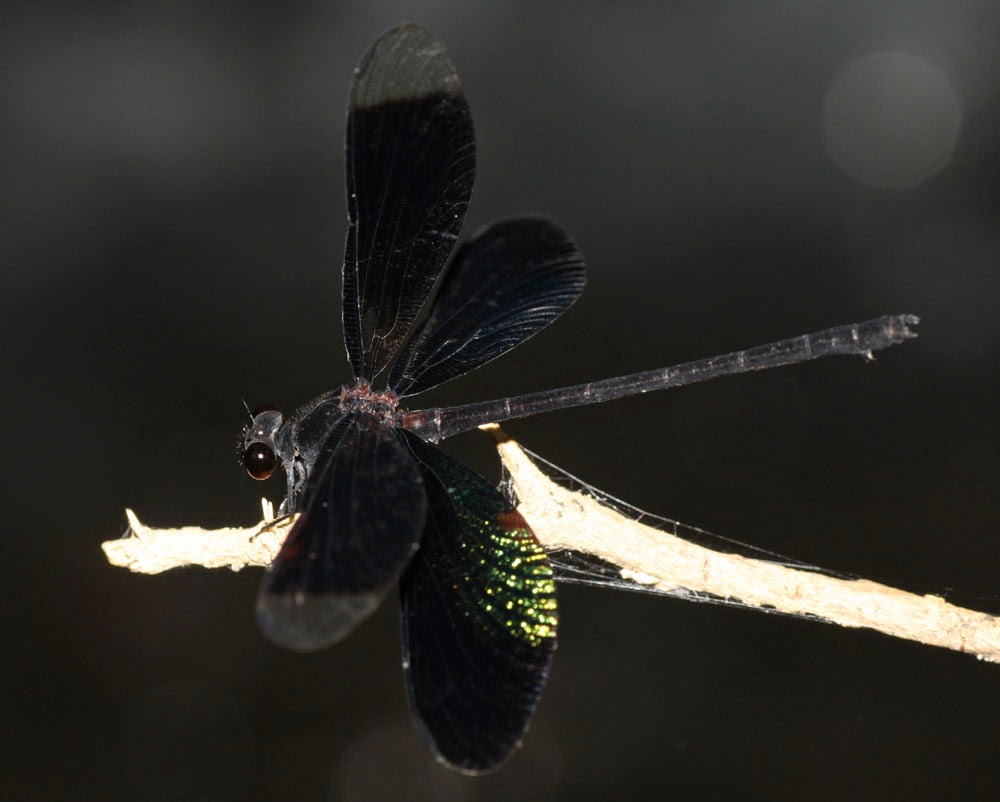
A medium damselfly, this species has dark body and wings in lateral view. The head is black; the thorax of male is dust black, and dark brown with yellow strips markings in female. The legs are short and stout with a row of teeth on front edge of femurs. The wings of male are dark and on upper side and in the sunlight, the hind wings have green/blue flash (the color changes up to position of view) on basal anal area. In female, wings are hyaline with basal orange-yellowish area. Male abdomen is black with a stuff of hairs on lower apical corner of segment tenth in lateral view.


The mature forms do not fly very far from their breeding habitat; they live at clear streams in good forests. The males are not easy recognized in shade but in sunshine they show their hind wings with green metallic flash for territorial and courtship behavior. 

Male with blue hind wing, photographed by Cuong Do, Quang Binh Province

Male with green flash hind wing, photographed by Cuong Do, Quang Binh Province

Blue hind wing male, photographed by Cuong Do, Hon Ba, Khanh Hoa Province


Wednesday, April 16, 2014

Heliocypha biforata biforata (Selys, 1859)

Very similar to H. perforata, they are also black and cobalt-bluish marking damselflies. Their wings are narrow like H. perforata but the iridescent areas on the wings are broader. Males of the species are distinct by markings on the synthorax and the abdomen. The abdomen of male is stouter than it of H. perforata, with distinct blue markings on lateral side of each segment. Females have no valuable in identification of the species. Their habitats, territorial and courtship behaviours are very similar to it of H. perforata, but H. b. biforata prefer opened running waters. They are widespread species but distribute locally.

Young male, photographed by Cuong Do, Quang Binh

Thorax marking of full mature male, photographed by Cuong Do, Phu Yen


Philoganga vetusta Ris, 1912

This species was described by Ris in 1921 in the taxonomy descriptions of Odonata that had been collected from Taiwan, South China, Tonkin (Vietnam) and Philippine.

A robust damselfly, rest with the wings in a horizontal position. The face, thorax and abdomen are black with green and yellow marking. The colour of the body changes in states of the body developing. The teneral form is very fade with light brown and bright yellow marking, then the body changes into shining black with yellow and green marking or orange marking. They are petiolated wing damselflies, but with many antenodal cross veins on the wings.

They live in jungles and the larvae live in the clear running water with muddy or rocky bottom, under shade of the forests. They usually are found in good forest of limestone mountain areas but occasionally found in secondary forests where the nature environment is not disturbed too much.


They are weak flying damselflies and usually rest highly in the bush of branch of trees.

Male, eating a fly, photographe by Cuong Do, Quang Binh

A young male, photographed by Cuong Do, Tam Dao National Park