Custom Search

Saturday, April 5, 2014

From Botanist to Odonatologist

Since my first selection of a main object at university time, it has been more than 14 year, as I was a botanical student in Hanoi University of Science. Working hardly in 2 and haft years in Botany Faculty, I learned the systematic of flower fauna in Vietnam that mainly focus on the origin of the flower plants. I did a serious study on flower plant in Lang Son Province, North Vietnam where was considered to be the center of the first flower plant of the world. That theory relates to the relationship between flower plant, pollen transferring and insects. Beetles are insects that were considered the main factors of the pollen transferring at the begging time as they were considering the first group that fly to the ancient flowers to eat the pollen. I was impressed very much in the relationship between flowers and insects with complicated evolution of the relationship of two creature groups.
At that time I did my thinking about the diversity of flowers, we had a field trip to Tam Dao National Park for third year students. We spent a week to “play” with nature in Tam Dao. My impression was gained very much with the colorful, diversity  and very very big size insects in the National Park.  The story about Cheriotonus that are long arm beetles in the town, that discussed by local people made my really to be curious. More ever, I saw a collector from Japan, who is trading a number of stag beetles with very much surprising. I kept all that images in my mind to back the university after that first field trip to Tam Dao. After about 3 months considering, with some private reasons, I decided to change my object of my life, I selected entomology for my graduate subject and mosquitoes controlling for finishing my graduated thesis. Medicine entomological laboratory in National Institute of Hygiene and Epidemiology is one of the best entomological laboratories in Hanoi that time. I did try to fight again the developing of the mosquito populations but I quickly recognized that it is easy to win the insects in a short period but at the end, people always to be loser.  With the thinking of not easy to be success in applied entomological field and it was very possibility that I could not get the official position in the good laboratory in NIHE, I applied to some other works.
Four years working in a publishing house is the next period of my life; the main job was reading, discussing with the authors and editing the manuscripts. That kind of mission is quite interesting but it is not real thing that I want to do. I missed field trips, theories and forest very much, that make me applied to study the master degree on entomology in Hanoi University of Science. Again, I have an opportunity to select an object to study. Mosquitoes and controlling was more than enough for me that time, and I really wanted to select a group of insect that more colorful, and had been in my dream in the first field trip to Tam Dao. Jewelry beetles or Buprestidae are the first thing that came to my mind, not dragonfly. I love their color wings and they also eat the pollen as well, an image that related to my knowledge of botany. However, the life always very difference from what you want. To collect beetles, there was only one way that I known that time, it is using the light trap, in fact for Buprestidae, you can use a long net and catch them on the flowers during the day. Thinking of a hard work at night and only me with a heavy generator did destroy my dream of coleoptera that time. So, there was only way to continue my hobby of entomology, select a day flying insect group. Butterfly is a group with too many species for a single researcher with more than 1000 species around Vietnam. The next group that I considered that time is of course dragonfly. Since the time, my life of being an odonatologist was beginning, 2001…

Camacinia harterti Karsch, 1890

In the field trip with my wife in 2009 (honey moon trip + field trip) to Tam Dao National Park, I found a new record of very beautiful dragonfly, Camacinia harterti Karsch, 1890. It was recorded the first time in Vietnam, the species is large dragonfly and to be the second species of the genus be found in the country. Not same to its related species, Camacinia gigantea, that found very common in low land in South East Asia, C. harterti was found in high mountain forest that not strong disturbed.

This species is brighten colorful with a nearly hyaline wings, red abdomen with lemon yellow basal segments. It is unbelievable discovery because it is very rare and Tam Dao fauna has been researched very often in 20 years recently.

C. harterti is quite rare and be found on the way from the main Town of Tam Dao to Tam Dao 2, there has not been any other record of this species since 2009 in Tam Dao.

Male of Camacinia harterti in Tam Dao National Park, taken by Cuong Do (14.IV.2009)

Habitat of C. harterti, my wife in the trip to Tam Dao, 2009


Atrocalopteryx fasciata Yang, Hamalainen & Zhang, 2014

The new species of very beautiful Caloptera damselfly was found from Yunnan, collected by the first author of the species, be confirmed by second and third author.

The new species is close to its related species Atrocalopteryx laosica that was recorded from Laos and Vietnam. They are easy separated by the differnce of wing color marking, A. laosica has darker wings while A. fasiata has clear part at wing apex and base.


Calopterygidae is one of the most colorful insect group among Odonata order, Matti Hamalainen (third author of the species) is the world expert of this group, Haomiao Zhang (the second author) is young actives odonatologist who interested in many groups of Odonata, he found many new species of Odonata from China.


Atrocalopteryx fasciata, holotype from the original description

Atrocalopteryx laosica, taken by Cuong Do in Sa Pa, Lao Cai Province, North Vietnam (29.VII.2006)


Sunday, March 30, 2014

Neolucanus baongocae Nguyen, 2013

In the field trip to Lam Dong and Khanh Hoa Province in 2013, a Vietnamese researcher of Lucanidae, Mr. Nguyen Quang Thai, has found an extreme beautiful Neolucanus. The species then be described by him undername N. baongocae Nguyen, 2013; it be name after his little daughter.

The new species is typical with brighten color, red pronotum and brown yellow elytra, that not be seen in any Vietnamese Neolucanus. Lucanidae is a well known and one of the most completed studied insect group so the new discover of a species in the family is one of remarkable point of entomology.

Males/Paratypes of N. baongocae in dorsal view, photographed by the author (in the original description)

Holotype of N. baongocae in lateral view, photographed by the author (in the original description)


Komiyasoma lei Drumont & Do, 2013

In the field trip last year (2013), we collected some strange specimens that closed to the new described genus Metaegosoma which consisted of two members, M. annamensis and M. pinci.

After examination the series of materials from South Center of Vietnam, we concluded that it is an undescribed genus then erected the genus Komiyasoma that obtained only single species K. lei.
The species is seem to an endemic species and found from highland forests in South Center of Vietnam.
The species was named after Mr. Le Van Huong, director of Bidoup National Park, Lam Dong Province while the name of the genus for honor Mr. Ziro Komiya, a Japanese who contributed many works on taxonomy of Prioninae of the World.

Male paratype of K. lei

Female paratype of K. lei


Wednesday, March 19, 2014

Teinopalpus imperialis (Kaiser-i-hind swallowtails) from Vietnam

Kaiser-i-hind swallowtails butterfly (Teinopalpus imperialis) is one of rare Papilioninae, they distributed in high mountain, the males are more common than the females. The matures appear in early morning, at the summit area of high mountain forests. In the first sunlight of the day, the males fly up above the tree canopy and waiting for the females that will fly up later from the forests. A female with larger wings is attractive object of males, as soon as the female appears, males will fly follow her in very high speed for mating purpose. The competition factor of males is speed and the fastest male will get the female. It is an unusual case in insect world, the true of other insect groups, males always more colorful or more attractive, but for this species, males need to be simple shape and speed is the most important to get his own female or to make next generations.

There are 3 among 8 subspecies of Teinopalpus imperialis have been recorded from Vietnam: Teinopalpus imperialis glilessi, Teinopalpus imperialis imperatorix and Teinopalpus imperialis herteri. While two subspecies glilessi and imperatorix are found in North Vietnam, the subspecies herteri only found from South Center of Vietnam. In dorsal view, the males are very similar, the main characteristic to separate males of that three subspecies is black marking on underside of their fore wings.

In Vietnam, the subspecies T. imperialis glilessi found from Lao Cai - Ha Giang mountain forests but T. imperialis imperatorix is rarer, only found from Cao Bang Province.

Teinopalpus imperialis glilessi (Male, dorsal view)

Teinopalpus imperialis glilessi (Male, ventral view)

Teinopalpus imperialis herteri (Male, dorsal view)


Teinopalpus imperialis herteri (Male, ventral view)


Sunday, March 9, 2014

Dung beetles collecting in Tam Dao

My first dung beetles collecting in Tam Dao National Park

The idea to do a first collecting trip this year (2014) gave by a Czech Collector of beetles. The weather now still cold with some rain of the spring. I never have done any field trip in this season and it sound crazy because of no flying insects this time. 
Miguel suggested to do a dung finding trip and he promised that we can see some scarab beetles as scarabaeinae or geotrupidae.


Tam Dao forest in rainy day

Well, I can't wait for more than a month and we agreed to arrange a trip to Tam Dao to see what is happening in this season. And it is not bad idea if some one invite you something difference, this case is "shit party", what ever it be called, we will try it at least one time. We arrived at the bottom of Tam Dao mountain in middle of the day, a cloudy and rainy day, everything wet and never same to any insect collecting day I tried before. It was cold enough to keep all the insects not flying on the way we go up, and we need to find a "good" dung of cow. A "good dung" is understood as a dung with 2 days old, it must not too fresh but not too old.

The first dung be found near the main road, up to the town of Tam Dao, at middle of the drain, showed by Quang Thai, a Lucanid researcher, this is also the first "dung" trip for him. His face look quite happy as be first person who found the object, Miguel looked at the "dung" near Thai's position and said that "it is too fresh". Well, in a rainy day, I wonder how he can know which is a fresh or not fresh shit of a cow, what ever I believed him and maybe it was not only one cow dung in Tam Dao, of course I also don't want check that kind of thing if Miguel be true, "fresh dung", it is not "fresh air" or "fresh water", not really good feeling.


We continued the trip and again, Thai informed us about another shit, it be on the ground this time, the dung was decorated with some plantations and fugues.  


The second dung before the operation with nature shape

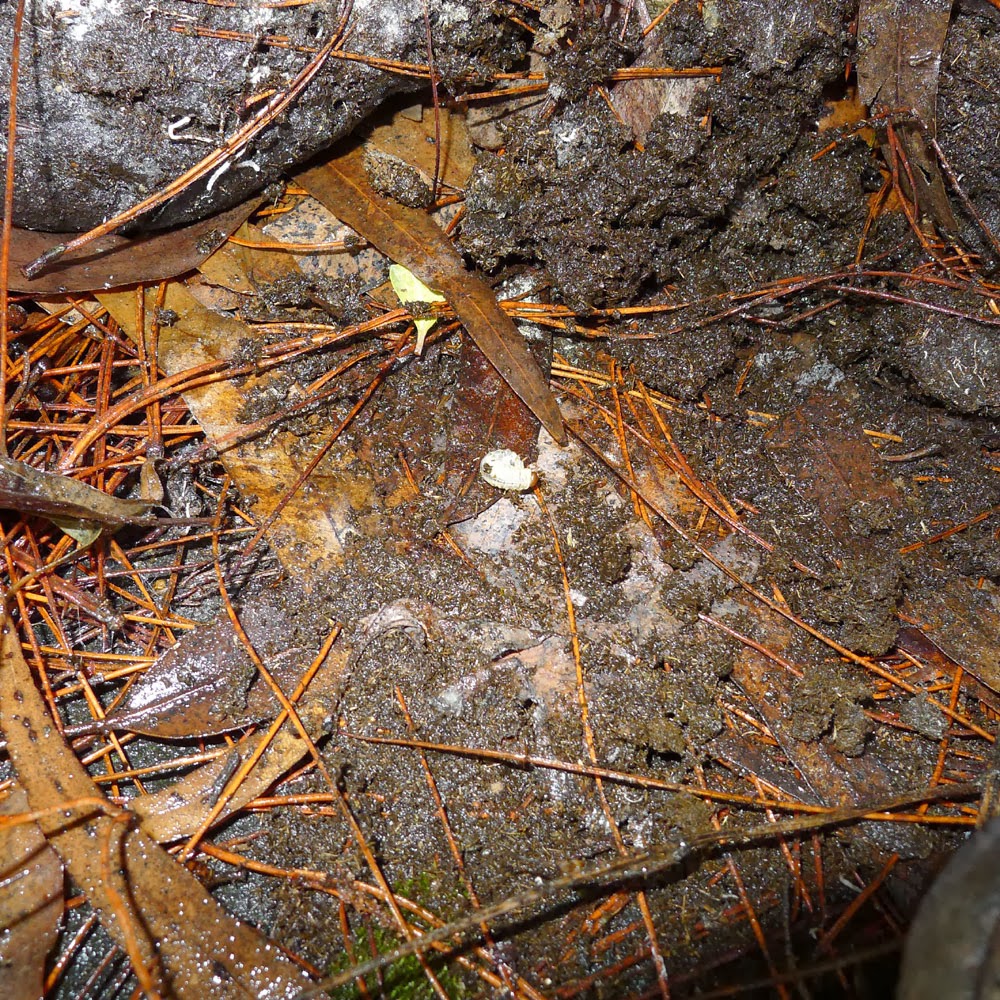
Because due to the time, dung to be so rare and we decided to check the content of the new discovery, the dung look maybe too old because the color changed and grass and fugues already appear around. Indeed, no mature form of beetle be found, they already done the eggs laying and one of them had hatched with evidence of one larva in side. 

The second finding with a single larva in the middle of "too old dung"

Then finally we found a very very good place with about 20 dungs around, and because the large number, the possibility of  "good dung" to be very high. At the first searching, of of horned scarab beetle be found between the layer of feces and ground. All the people be happy very much with the cow's product, the beetles just come for their next generations. I read about dung beetles collecting but not the thing that I done today, not too fresh but still smelling and the felling is not same to my feeling in the past as collecting insects. 
Dragonflies found very colorful and fresh, shinning in the clean water areas; light trap is hard work but no smelling, fruit trap for butterflies and centoniinae is not easy for breathing but it much more better than cow shit.

One of the first discovery, and very "fresh" also! Copris sinicus identified by Denis Keith

I also tried with one of them but this is not really easy work

Sometime for this kind of small beetle, you need to dig a whole shit


But 2 hours working is not really hard if the result be showed (only one serious worker, Miguel).
Some of them quite special, as this horned beetle, it look not like its smell after cleaning...
Liatongus vertagus identified by Denis Keith

 
A Geotrupidae

And two yellow spots beetles (I wonder what the color spots for if they just in side of the dung)

Not only scarab beetles, a staphylinidae also be found, maybe special one

It was a really not bad result in a cloudy and rainy cold day, though you still can see some Erycaceae or Theaceae flowers:
Small bug in side of Erycaceae in Tam Dao

A red theaceae, very attractive food of horn rutelinae (Fruhstorferia anthraciana)

So the dung beetles are still good looking without the fact that they live and eat bad smelling things; without them, maybe this world is just a big shit. 

And before to shake a hand of entomotlogist just come back from the field, don't forget asking him what insect group that he is studying, be careful with some coleopterists, just say Hello some time is more than enough....

Monday, March 3, 2014

Neolucanus delicatus Didier, 1927

This species had been misidentified with Neolucanus fuscus Didier, 1926 that found from North Vietnam (Tam Dao, Sa Pa, Tuyen Quang...) and South China. The true Neolucanus delicatus was found from Quang Nam Province, the center of Vietnam, and it is considered as a narrow distributed species and very possibility that the species is an endemic creature (only found from Center of Vietnam). Not as related species Neolucanus fuscus, species Neolucanus delicatus only found in black form with the very slender and curved up mandibles. Mandibles of N. fucus are more robust and not so up curved as them of N. delicatus.

Neolucanus delicatus (dorsal view)


Neolucanus delicatus (lateral view), show the very slender and curved up mandibles

Sunday, March 2, 2014

Lucanus kraatzi giangae Ikeda, 1997

The taxon was described by Haruo Ikeda as a subspecies of Lucanus kraatzi Nagel, 1926.
The subspecies L. kraatzi giangae found from North Vietnam, near Vietnam-China border. The taxon also considered as Vietnamese endemic subspecies. The subspecies was named after a Vietnamese, who is the wife of a Japanese's collector, Ms. Doan Lan Giang. 

The subspecies can be easy separated to L. kraatzi kraatzi Nagel, 1926 based on the position of the middle teeth on mandible. The teeth about the middle of mandible in L. kraatzi giangae but it look near the apex in L. kraatzi kraatzi. The size of L. kraatzi giangae also larger than it related subspecies. L. kraatzi kraatzi was found in Yunnan Province, South China.

L. kraatzi giangae was found in the good forests with elevation about 1900m.

Lucanus kraatzi giangae Ikeda, 1997 (dorsal view)

Lucanus kraatzi giangae Ikeda, 1997 (oblique view)

Saturday, March 1, 2014

Hystatoderes weissi Lameere, 1915

In my collection, there is a male prionid that was collected from south center of Vietnam last year (2013), as trying to identify the specimen, I found that it is maybe closes to Drumontiana, a genus that erected by Mikhail Danilevsky in 2001. I emailed to Mikhail for the original description and checked all the document on Drumontiana published by Komiya and found that my material is true closed to Drumontiana but not belong the genus because the number of antenna segments. There are only 9 segments in Drumontiana but 11 of them in my specimen.

There is another genus that I considered, the very rare Psephactus that found from Taiwan, Japan and Malaysia. However I quickly found that my material can not be Psephactus because its elytra, not same to Psephactus, my material with long elytra and not as short as all member of the genus. So only one male of my collection not yet known in genus level and maybe something very rare. I continued searching all the genus that closes to Drumontiana, in the area, there are only 2 genera of the tribe Mecroscelisini that not be confirmed with my specimen: Hystatoderes and Sarmydus. But the Sarmydus is clearly separated by the short tibia and tarsus, the antenna also very depressed. Then the last confusing is Hystatoderes, a genus with single species H. weissi by Lameere in 1915, under the genus Emphiesmenus.

On the species H. weissi, this species is well known with the female rather than the male, my material is male specimen. In the original description,  Lameere described this species base on a single female that collected from North Vietnam, the specimen was deposited in Paris Museum of Nature. I try to find the photo of the female in the Museum website but it did not worked, no photo at all.

Making some emails to my fellows, Francesco, Antonio and Mikhail, I got the paper by Drumont et al. with the reviewing of the genus Emphiesmenus in 2000 from Francesco. In the paper, Alain and his fellows confirmed about the female specimen that Lameere described as vitalisi in 1917 is the synonym of weissi and the species be placed in the genus Hystatoderes. The photo of the female also given in Drumont et al. paper. In my database, Ziro sent me his pdf before, the Komiya and Nisanto, 2001 in which the male and female photos of the species be published, however the photo of the male is very poor and look like there is only one lateral spine on pronotum. The full structure of the male had not been known and I did have to continue finding the description.

Antonio helped me some descriptions of the female H. weissi and he suggested that the male description should be published by Gressit and Rondon in 1970. And it is the reason why the species be recorded in Laos. I emailed to Mikhail and asked him about the paper because Antonio did not have this book with him that time. Milkhail replied that he could not find any Hystatoderes in the book, I asked him try again with Emphiesmenus. Mikhail sent back to me later the description of the male of E. weissi, very clear and understandable structure with black and white photos of both male and female. My specimen is true H. weissi and all the characteristics matched very well with the description.

So happy with the result, my material male is true H. weissi and recorded the first time in South Center of Vietnam. I did hope that maybe it is a new species because Sa Pa and Hoa Binh are two sites of type specimens but very far from center of Vietnam. And in the Komiya and Nisanto paper, the pronotum looks only has 1 lateral spine. Now everything clear enough to understand, H. weissi the only species of the genus can be found not in a narrow area, maybe in the past, the species quite common in the Indo-China region, my opinion maybe this species can be found in Yunnan, or South of China. It is not a new species, but interesting taxon in my collection.

Hytatoderes weissi Lameere, 1915 (Do Collection)

The first description of the male by Gressit and Rondon in 1970.

Thank you so much to my fellows and friends: Francesco, Antonio, Ziro, Alain and Mikhail for helping me.

Note: There still a confusing, it is the photo of the male in Komiya and Nisanto paper, the male in my view looks only with a single spine on lateral side of pronotum and two composed eyes of the specimen looks not close together. Until the specimen in the paper be confirmed, I have not been sure about the taxonomical position of the species that gave by Komiya and Nisanto.