Custom Search

Monday, May 16, 2016

Eupanacra busiris busiris (Walker, 1856)

Eupanacra busiris busiris (Walker, 1856) is quite wide distributed species, they found from India to South East Asia and South China. There are 5 subspecies of the species E. busiris be described. Eupanacra busiris atima found only from India; Eupanacra busiris marina found in Andaman Islands (India); Eupanacra busiris myosotis was described from Indonesia and Eupanacra busiris schuetzi found in Philippines. They are plant mimic moths, the whole body marking of the species similar to an orchid trunk. Color of dried specimen very much difference from alive form.


Eupanacra busiris busiris (Walker, 1856) - photographed by Ly Phu Tai


Eupanacra busiris busiris (Walker, 1856) - photographed by Nguyen Ba Quang


Saturday, May 14, 2016

Xyleutes persona Le Guillou, 1841

Species of Xyleutes are large size moths of Cossidae, there are 2 species were recorded from Vietnam:  Xyleutes persona Le Guillou, 1841 and Xyleutes strix (Linnaeus, 1758). Both of the species are wide distribute from India to South East Asia, Papua New Guinea, Xyleutes strix (Linnaeus, 1758) found also in Solomons. In Vietnam, Xyleutes species found in mountain forests with elevation from 700 to more than 1000m. The species Xyleutes persona Le Guillou, 1841 was recorded the first time by Yakolev & Witt in 2009. 2 species of Xyleutes can be easy separated by color of the pronotum: Xyleutes persona with a white pronotum while Xyleutes strix has black part of pronotum in dorsal view.


Xyleutes persona Le Guillou, 1841 - photographed by Cuong Do


Marumba spectabilis (Butler, 1875)

Marumba spectabilis (Butler, 1875) is one of 6 species of Marumba that found from Vietnam: Marumba cristata (Butler, 1875), Marumba dyras (Walker, 1856), Marumba gaschkewitschii (Bremer & Grey, 1853), Marumba saishiuana Okamoto, 1924, Marumba spectabilis (Butler, 1875) and Marumba sperchius (Ménétriés, 1857). The species Marumba spectabilis (Butler, 1875) and Marumba saishiuana Okamoto, 1924 very similar in shape of wings as well as marking on on the wings.


Marumba spectabilis (Butler, 1875) - Photographed by Cuong Do


Marumba spectabilis (Butler, 1875) moving its wings at night


Cypa decolor (Walker, 1856)

There are 2 species of genus Cypa that found from Vietnam, Cypa decolor (Walker, 1856) and Cypa enodis Jordan, 1931. They are very similar and the characteristic to separate them is the hind wings structure. Cypa decolor (Walker, 1856)  found in South of Vietnam while Cypa enodis Jordan, 1931 found in North Center of Vietnam.
Cypa enodis Jordan, 1931 found in both pristine and disturbed forests with elevation from 700 to more than 1000m.


Cypa decolor (Walker, 1856) - photographed by Cuong Do


Friday, May 13, 2016

Cephonodes hylas (Linnaeus, [1771])

Cephonodes hylas (Linnaeus, [1771]) is a wide distribute and common species, they have been recorded from Near East, Middle East, Africa, India, China, Japan, South East Asia and Australia. They are bee mimic moth and day flying insects with hyaline wings are not same to any other members of Sphingidae.
There are 2 species of the genus were found in Vietnam, the second species smaller: Cephonodes picus (Cramer, 1777)


Cephonodes hylas (Linnaeus, [1771]) - photographed by Ly Phu Tai, Bao Lam, Bao Loc, Lam Dong Province

Dahira obliquifascia (Hampson,1910)

Dahira obliquifascia (Hampson,1910) is a wide distribute species of Indochina region, the species found also in South China and South of Thailand as well. This species and Dahira rubiginosa Moore, 1888 are two only members of the genus that were recorded for fauna of the country. Not so common locally, the species found in vary of elevation and also be recorded in disturbed forests.


Dahira obliquifascia (Hampson,1910) - photographed by Cuong Do


Sphinx centrovietnama Brechlin, 2015

Sphinx centrovietnama Brechlin, 2015 is a new described species, the holotype of the species was found from Ngoc Linh, Kon Tum Province. It is the second species of the genus found in Vietnam, the first recorded species of the genus is Sphinx oberthueri (Rothschild & Jordan, 1903) maybe somewhere around Fansipan Mountains,  Dr. Ian Brechlin proposed that it never be recorded officially from Vietnam or misidentified from S. centrovietnama because their differences are not easy to be recognized.


Sphinx centrovietnama Brechlin, 2015 - photographed by Cuong Do


Thursday, May 12, 2016

Neogurelca hyas (Walker, 1856)

Neogurelca hyas (Walker, 1856) is wide distributed species however it is not common locally. The species was found from India to Indochina, Japan and Indonesia.
In Vietnam, this species was record in disturbed forests with elevation about 500-700m.


Neogurelca hyas (Walker, 1856) - photographed by Cuong Do


Wednesday, May 11, 2016

Rhodoprasina callantha Jordan, 1929

Rhodoprasina callantha Jordan, 1929 is one of two members of the genus Rhodoprasina that found from Vietnam. The species Rhodoprasina callantha Jordan, 1929 is more common (about Indochina,  Yunnan and Bhutan)  and wide distributed while the other smaller species: Rhodoprasina winbrechlini Brechlin, 1996 is quite rare and found only from North East of Vienam and Yunnan, China.
Despite of  more wide distribute, Rhodoprasina callantha Jordan, 1929 is not common locally, they found in good forests with elevation from 400 to more than 1000m.

Rhodoprasina callantha Jordan, 1929 - photographed by Cuong Do

Tuesday, May 10, 2016

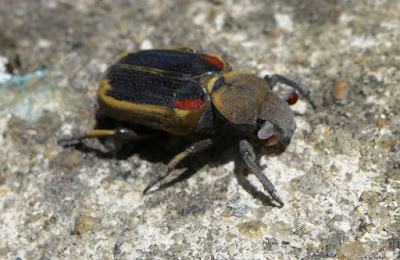
An undescribed species of genus Clinterocera

This is an unnamed species of Clinterocera genus and close to Clinterocera jucunda Westwood, 1874 that found from North Vietnam, North Thailand and Laos. Among 27 species of the genus there are only 5 known species that already be found from Vietnam: Clinterocera davidis Fairmaire, 1878; Clinterocera discipennis Fairmaire, 1889; Clinterocera jucunda Westwood, 1874; Clinterocera raui (Paulian, 1961); Clinterocera rufithorax Moser, 1901.
I am not an expert of Cetoniinae but the species is so beautiful and I really want to make a description of it; I hope I will have an opportunity to give it a science name in the near future.


Unnamed species of Clinterocera - photographed by Cuong Do